
2020
Demak MV 135 - Specifications & Review
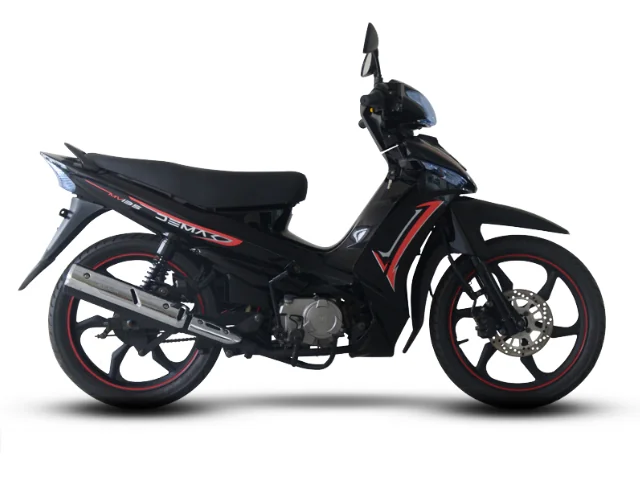
Article Complete Info
| Articleid | 919813 |
|---|---|
| Category | Scooter |
| Make | Demak |
| Model | MV 135 |
| Year | 2020 |
Chassis, Suspension, Brakes & Wheels
| Frametype | Steel |
|---|---|
| Frontbrakes | Single disc |
| Frontsuspension | Telescopic fork |
| Fronttyre | 70/90-17 |
| Rearbrakes | Expanding brake (drum brake) |
| Rearsuspension | Twin shocks |
| Reartyre | 89/90-17 |
| Seat | 2-person seat |
| Wheels | Black 6-spoke wheels |
Engine & Transmission
| Coolingsystem | Air |
|---|---|
| Displacement | 135.00 ccm (8.24 cubic inches) |
| Enginedetails | Single cylinder, four-stroke |
| Fuelsystem | Carburettor |
| Gearbox | 4-speed |
| Power | 8.80 HP (6.4 kW)) |
| Transmissiontypefinaldrive | Chain |
Other Specifications
| Coloroptions | Black |
|---|---|
| Comments | Cub sold in Asia. |
| Electrical | 12 Volt 5 Ah battery |
| Starter | Electric & kick |
Physical Measures & Capacities
| Dryweight | 92.0 kg (202.8 pounds) |
|---|---|
| Overallheight | 1,090 mm (42.9 inches) |
| Overalllength | 1,930 mm (76.0 inches) |
| Overallwidth | 650 mm (25.6 inches) |
| Powerweightratio | 0.0957 HP/kg |
About Demak
Country of Origin:
Malaysia
Founder:
DNC Asiatic Holdings
Best Known For:
Affordable kapchai/underbone commuters and scooters for Southeast Asia
Company History
Demak (under DNC Asiatic Holdings) built its presence by assembling and distributing affordable commuters for Malaysia and neighboring markets. The brand’s lineup centered on underbones and 110–150cc scooters—machines that shine in congested Southeast Asian cities thanks to narrow profiles, low running costs, and step-through practicality in tropical rain. By investing in local assembly, Demak could adapt quickly to regulatory shifts, secure duty advantages, and tailor suspension and gearing to Malaysian roads. Dealer networks—often independent, community-anchored shops—handled sales and spares, building trust among riders who depend on their bikes for work and family transport. While the brand competed against heavyweights from Japan and increasingly sophisticated Chinese entrants, Demak remained relevant by leaning into value propositions: cash prices within reach, parts on the shelf, and straightforward service procedures that local mechanics knew well. Historically, Demak illustrates the regionalization of the motorcycle business: even in the era of global platforms, success can hinge on understanding local usage patterns—wet markets at dawn, school runs at noon, and rides to the kampung on holidays. In this context, Demak’s contribution is measured in kilometers of reliable service rather than in top-speed figures. It helped expand mobility for thousands of households, reinforcing the critical role underbones play in Southeast Asia’s social and economic fabric.