
1957
Douglas Dragonfly - Specifications & Review
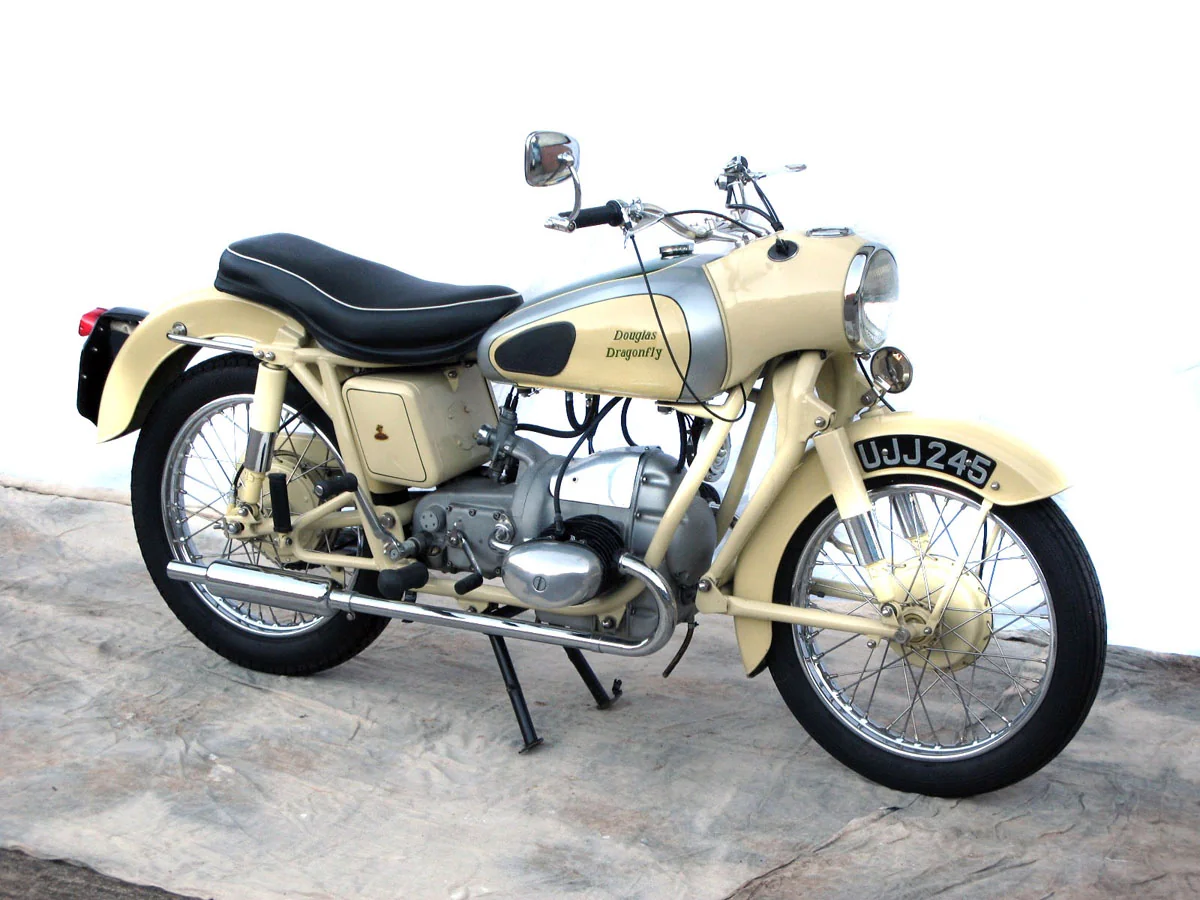
Article Complete Info
| Articleid | 390663 |
|---|---|
| Category | Sport |
| Make | Douglas |
| Model | Dragonfly |
| Year | 1957 |
Chassis, Suspension, Brakes & Wheels
| Frametype | Tubular duplex cradle |
|---|---|
| Frontbrakes | Expanding brake (drum brake) |
| Frontsuspension | Leading link |
| Rearbrakes | Expanding brake (drum brake) |
| Rearsuspension | Hydraulic Shock Absorber |
| Seat | Dual |
| Wheels | Spoked |
Engine & Transmission
| Displacement | 348.00 ccm (21.23 cubic inches) |
|---|---|
| Enginedetails | Twin, four-stroke |
| Fuelsystem | Carburettor |
| Ignition | Coil |
| Power | 17.00 HP (12.4 kW)) @ 5500 RPM |
| Transmissiontypefinaldrive | Chain |
Physical Measures & Capacities
| Dryweight | 166.0 kg (366.0 pounds) |
|---|---|
| Fuelcapacity | 25.00 litres (6.61 gallons) |
| Powerweightratio | 0.1024 HP/kg |
About Douglas
Country of Origin:
United Kingdom
Founder:
William and Edward Douglas (with early engineering by Joseph Barter)
Best Known For:
Fore-and-aft flat-twin motorcycles; Dragonfly and earlier models
Company History
Douglas of Kingswood, Bristol, is inseparable from the fore-and-aft flat-twin, an engine layout that gave its bikes a distinctive narrow profile and smoothness. Emerging from a foundry business in the early 1900s, Douglas produced elegant, compact motorcycles that earned acclaim in competition and on the road—reliability trials, the Isle of Man TT, and police fleets. The alignment of the crankshaft with the frame simplified gearbox placement and contributed to a signature mechanical feel. Between the wars, Douglas diversified into speedway machines and sidecar tugs, leveraging the twin’s torque and serviceability. Post-WWII, the Dragonfly arrived with refined styling and chassis updates, but Britain’s industry faced headwinds: rising car ownership, fierce overseas competition, and capital constraints. Production wound down in the 1950s. Historically, Douglas represents a particularly British blend of innovation and understatement—engines that felt civilized, frames that handled predictably, and finishes that rewarded close inspection. Surviving bikes draw enthusiasts who value the layout’s character and the brand’s role in early TT lore. To ride a Douglas today is to experience a thoughtful alternative history of powertrain packaging, one that still feels logical and charming decades on.