
2020
Ducati Supersport S - Specifications & Review
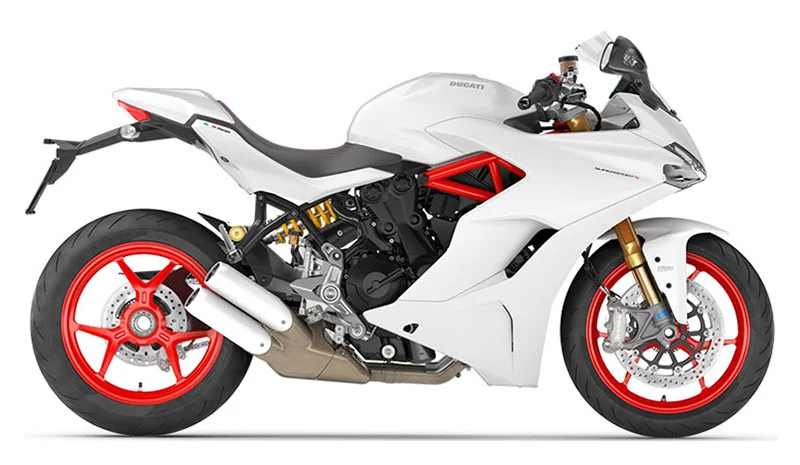
Article Complete Info
| Articleid | 193996 |
|---|---|
| Category | Sport |
| Make | Ducati |
| Model | Supersport S |
| Year | 2020 |
Chassis, Suspension, Brakes & Wheels
| Frametype | Tubular steel Trellis frame attached to the chylinders head |
|---|---|
| Frontbrakes | Double disc. ABS. Floating discs. Four-piston calipers. Radially mounted. |
| Frontbrakesdiameter | 320 mm (12.6 inches) |
| Frontsuspension | Fully adjustable 43 mm usd Marzocchi fork |
| Fronttyre | 120/70-17 |
| Frontwheeltravel | 130 mm (5.1 inches) |
| Rake | 24.0° |
| Rearbrakes | Single disc. ABS. Two-piston calipers. |
| Rearbrakesdiameter | 245 mm (9.6 inches) |
| Rearsuspension | Progressive linkage with adjustable Sachs monoshock. Aluminium single-sided swingarm |
| Reartyre | 180/55-17 |
| Rearwheeltravel | 130 mm (5.1 inches) |
| Trail | 91 mm (3.6 inches) |
Engine & Transmission
| Borexstroke | 94.0 x 67.5 mm (3.7 x 2.7 inches) |
|---|---|
| Clutch | Wet multiplate clutch mechanically operated, self-servo action on drive, slipper action on over-run |
| Compression | 12.6:1 |
| Coolingsystem | Liquid |
| Displacement | 937.00 ccm (57.18 cubic inches) |
| Driveline | Chain; Front sprocket 15; Rear sprocket 43. Primary drive: Straight cut gears; Ratio 1.84. |
| Enginedetails | V2, four-stroke |
| Enginetype | Testastretta 11° L-Twin |
| Exhaustsystem | Lightweight 2-1-2 system with catalytic converter and two lambda probes. Twin aluminium mufflers |
| Fuelconsumption | 5.90 litres/100 km (16.9 km/l or 39.87 mpg) |
| Fuelsystem | Injection. Electronic fuel injection system, 53 mm throttle bodies with full Ride-by-Wire |
| Gearbox | 6-speed |
| Greenhousegases | 136.9 CO2 g/km. (CO2 - Carbon dioxide emission) |
| Power | 110.00 HP (80.3 kW)) @ 9000 RPM |
| Torque | 93.00 Nm (9.5 kgf-m or 68.6 ft.lbs) @ 6500 RPM |
| Transmissiontypefinaldrive | Chain |
| Valvespercylinder | 4 |
Other Specifications
| Coloroptions | Star White Silk, Ducati Red |
|---|---|
| Instruments | LCD Display |
| Starter | Electric |
Physical Measures & Capacities
| Dryweight | 183.0 kg (403.4 pounds) |
|---|---|
| Fuelcapacity | 16.00 litres (4.23 gallons) |
| Overallheight | 1,320 mm (52.0 inches) |
| Overalllength | 2,095 mm (82.5 inches) |
| Overallwidth | 860 mm (33.9 inches) |
| Powerweightratio | 0.6011 HP/kg |
| Seatheight | 810 mm (31.9 inches) If adjustable, lowest setting. |
| Weightincloilgasetc | 210.0 kg (463.0 pounds) |
About Ducati
Country of Origin:
Italy
Founder:
Adriano, Bruno, and Marcello Cavalieri Ducati (with Antonio Cavalieri Ducati)
Best Known For:
Desmodromic valve V-twins/V4s; superbike and MotoGP pedigree; Italian design
Company History
Ducati’s story begins in 1926 Bologna as a maker of radio components before postwar circumstances steered it toward engines and then motorcycles. From Cucciolo clip-ons to bevel-drive twins and on to belt-drive desmodromic L-twins, the brand cultivated a reputation for mechanical exotica that actually worked on the road. Racing success at Imola in 1972 set the tone, while the 851/888/916 lineage defined 1990s superbike aesthetics—Tamburini lines, single-sided swingarms, trellis frames, and the bark of a big twin. The 2000s brought sophisticated electronics, trellis evolutions, and Desmosedici MotoGP technology filtering to the street. Today’s V4s carry desmo heritage into new architectures, pairing intoxicating sound with blistering pace and rider aids that let mortals touch the edge. Yet the Ducati experience isn’t only lap times; it’s also design theater—red paint, machined details, and a sense that every component was considered. Historically, Ducati shaped what ‘Italian performance’ means: intense, beautiful, and emotionally involving. Owners speak of feedback through the pegs, the ritual of warm oil, and a community that treats a Sunday ride like an event. In an era of homogenized competence, Ducati insists that performance should move the soul as much as the stopwatch.