
2016
eCRP Energica Ego 45 - Specifications & Review
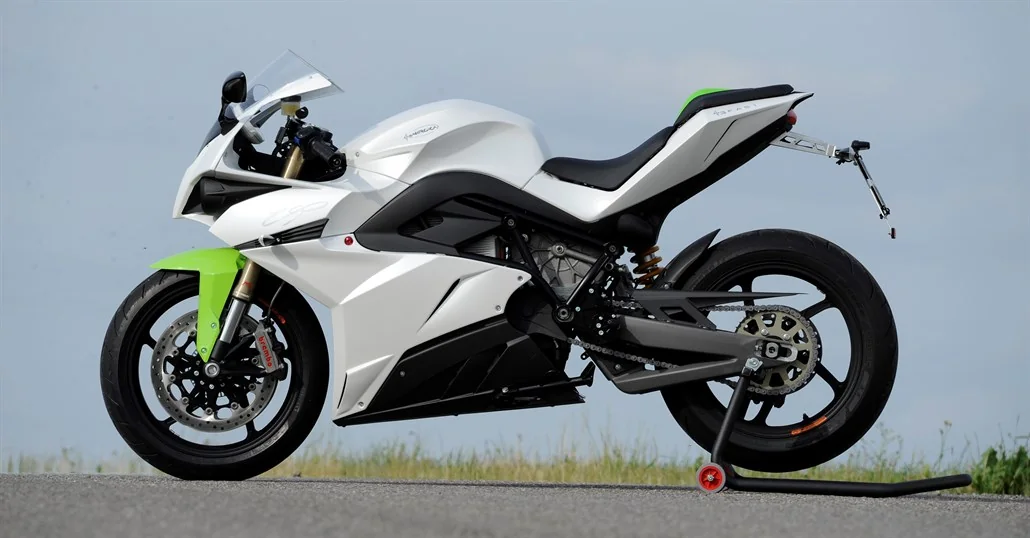
Article Complete Info
| Articleid | 946968 |
|---|---|
| Category | Sport |
| Make | eCRP |
| Model | Energica Ego 45 |
| Year | 2016 |
Chassis, Suspension, Brakes & Wheels
| Frametype | Steel tubular trellis. Aluminium alloy swing arm. |
|---|---|
| Frontbrakes | Double disc. ABS. Brembo 4 caliper radial mount. |
| Frontbrakesdiameter | 320 mm (12.6 inches) |
| Frontsuspension | Ohlins FGRT fork |
| Fronttyre | 120/70-17 |
| Rearbrakes | Single disc. ABS. Brembo. Single caliper |
| Rearbrakesdiameter | 220 mm (8.7 inches) |
| Rearsuspension | Ohlins Adjustable monoshock |
| Reartyre | 180/55-17 |
| Wheels | Oz forged aluminum. Pirelli Diablo Rosso II tires. |
Engine & Transmission
| Coolingsystem | Oil & air |
|---|---|
| Driveline | 525 O-ring chain |
| Emissiondetails | No direct emissions |
| Enginedetails | Electric |
| Enginetype | PMAC synchronous motor, permanent magnets |
| Power | 136.00 HP (99.3 kW)) |
| Topspeed | 240.0 km/h (149.1 mph) |
| Torque | 195.00 Nm (19.9 kgf-m or 143.8 ft.lbs) |
| Transmissiontypefinaldrive | Chain |
| Zerotoonehundred | 3.000 seconds |
Other Specifications
| Coloroptions | White, black, carbon |
|---|---|
| Comments | Italian brand. Small windshield. 11.7 kWh battery. Range 150-190 km. Charges to 85% in 30 minutes. Rear-wheel lift- up mitigation system. Switchable ABS. Park-assistant. |
| Instruments | Digital dashboard from COBO TFT |
| Starter | Electric |
Physical Measures & Capacities
| Dryweight | 258.0 kg (568.8 pounds) |
|---|---|
| Overallheight | 1,140 mm (44.9 inches) |
| Overalllength | 2,140 mm (84.3 inches) |
| Overallwidth | 720 mm (28.3 inches) |
| Powerweightratio | 0.5271 HP/kg |
| Seatheight | 810 mm (31.9 inches) If adjustable, lowest setting. |
About eCRP
Country of Origin:
Italy
Founder:
CRP Group (racing division)
Best Known For:
TTXGP-era electric racebikes that seeded Energica
Company History
eCRP was the racing arm of Italy’s CRP Group that dove headfirst into the first serious electric motorcycle championships (TTXGP and early FIM e-series). Rather than treat EVs as science projects, the team applied proper motorsport discipline: weight audits, thermal management under race load, rapid-change battery modules, and data logging to map the entire lap’s energy budget. The eCRP 1.0/1.4 machines demonstrated that a well-sorted electric chassis could be hustled with intent—strong initial acceleration, stable mid-corner behavior despite battery mass, and consistent lap-to-lap performance if temperatures were kept in check. Lessons learned on pack architecture, BMS strategy, and packaging around a dense energy core flowed straight into street-legal development, ultimately birthing Energica as a consumer brand. Historically, eCRP matters enormously because it validated the motorsport-to-street pipeline for EVs, much as internal-combustion racing had done for a century. It trained engineers and riders to think in new variables—charge acceptance, thermal derate, regen maps—without abandoning the old ones of geometry, damping, and tire behavior. For fans who watched the series in its raw early days, eCRP’s bikes were proof that the future wouldn’t be silent or sterile; it would be fast, data-rich, and increasingly beautiful. The program closed the loop between Italian racing passion and a new propulsion technology, setting the stage for a credible, desirable electric motorcycle industry.