
1968
Allstate SR 250 - Specifications & Review
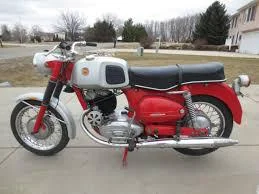
Article Complete Info
| Articleid | 632835 |
|---|---|
| Category | Allround |
| Make | Allstate |
| Model | SR 250 |
| Year | 1968 |
Chassis, Suspension, Brakes & Wheels
| Frontbrakes | Expanding brake (drum brake) |
|---|---|
| Frontsuspension | Telescopic |
| Rearbrakes | Expanding brake (drum brake) |
| Seat | Dual |
Engine & Transmission
| Coolingsystem | Air |
|---|---|
| Displacement | 250.00 ccm (15.26 cubic inches) |
| Enginedetails | Single cylinder, two-stroke |
| Fuelsystem | Carburettor |
| Power | 16.00 HP (11.7 kW)) @ 5800 RPM |
| Topspeed | 80.0 km/h (49.7 mph) |
Physical Measures & Capacities
| Dryweight | 140.2 kg (309.0 pounds) |
|---|---|
| Powerweightratio | 0.1142 HP/kg |
About Allstate
Country of Origin:
United States
Founder:
Sears, Roebuck & Co. (re-badged imports)
Best Known For:
Department-store scooters/motorcycles (Vespa, Puch, Cushman) sold under ‘Allstate’
Company History
From the 1940s through the 1960s, Sears sold re-badged scooters and small motorcycles under its Allstate brand, bringing two-wheel mobility to countless American households via catalogs and showrooms. Rather than manufacture, Sears sourced proven platforms—Vespa scooters from Piaggio, Puch two-strokes from Austria, Cushman domestics—and standardized parts, manuals, and financing for mainstream buyers. The approach democratized riding: teenagers and commuters could afford reliable transport complete with service parts mailed to their door. While purists bristled at the department-store badge, the machines themselves were authentic, sharing bones and spares with their original marques. Allstate’s success anticipated today’s big-box distribution ideas and proved that aftersales support and documentation could be as important as the badge. As motorcycle retail professionalized and Japanese brands built dealer networks, Sears exited the category, but the legacy remains visible in barns and suburban garages across America. Historically, Allstate is a story about access. It lowered barriers to ownership in an era before credit was ubiquitous, connected far-flung customers with quality European engineering, and seeded a generation of riders who learned to wrench from a Sears manual. Collectors now enjoy the juxtaposition: iconic European hardware wearing a uniquely American retail past.