
2024
Enfield Hunter 350 - Specifications & Review
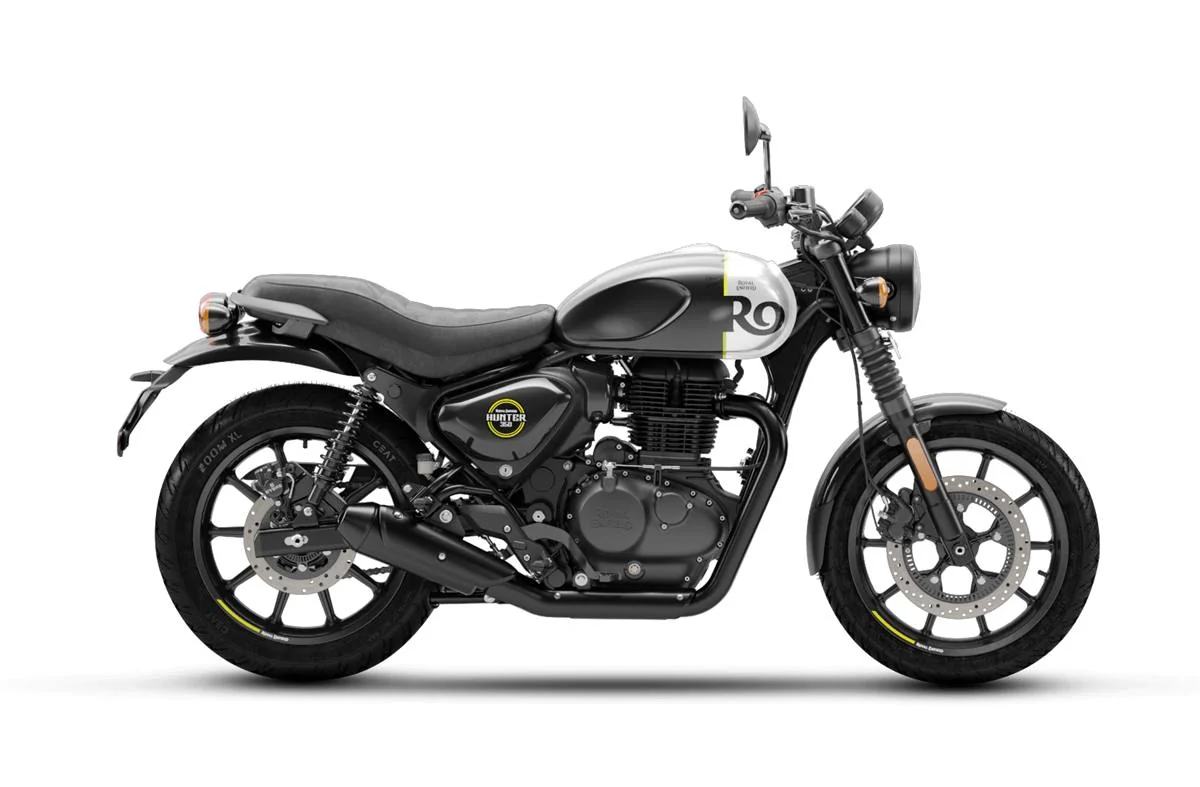
Article Complete Info
| Articleid | 87067 |
|---|---|
| Category | Classic |
| Make | Enfield |
| Model | Hunter 350 |
| Year | 2024 |
Chassis, Suspension, Brakes & Wheels
| Frametype | Twin Downtube Spine |
|---|---|
| Frontbrakes | Single disc. ABS. Twin piston. |
| Frontbrakesdiameter | 300 mm (11.8 inches) |
| Frontsuspension | Telescopic fork, 41 mm |
| Fronttyre | 100/70-17 |
| Frontwheeltravel | 130 mm (5.1 inches) |
| Rearbrakes | Single disc. ABS |
| Rearbrakesdiameter | 270 mm (10.6 inches) |
| Rearsuspension | Twin tube Emulsion shock absorbers with 6-step adjustable preload |
| Reartyre | 140/70-17 |
| Rearwheeltravel | 102 mm (4.0 inches) |
| Wheels | Alloy wheels, tubeless tyres |
Engine & Transmission
| Borexstroke | 72.0 x 85.5 mm (2.8 x 3.4 inches) |
|---|---|
| Clutch | Wet multiplate |
| Compression | 9.5:1 |
| Coolingsystem | Oil & air |
| Displacement | 349.0 ccm (21.30 cubic inches) |
| Driveline | Constant mesh |
| Enginetype | Single cylinder, four-stroke |
| Fuelconsumption | 2.65 litres/100 km (37.7 km/l or 88.76 mpg) |
| Fuelsystem | Injection |
| Gearbox | 5-speed |
| Greenhousegases | 61.5 CO2 g/km. (CO2 - Carbon dioxide emission) |
| Ignition | ECU |
| Power | 19.9 HP (14.5 kW)) @ 6100 RPM |
| Topspeed | 114.0 km/h (70.8 mph) |
| Torque | 27.0 Nm (2.8 kgf-m or 19.9 ft.lbs) @ 4000 RPM |
| Transmissiontypefinaldrive | Chain (final drive) |
| Valvespercylinder | 2 |
Other Specifications
| Coloroptions | Rebel Blue, Rebel Red, Rebel Black, Dappe Ash, Dapper White, Dapper Grey, Factory Black |
|---|---|
| Comments | Also called Royal Enfield HNTR 350. USB charging. Royal Enfield bikes are made in India. |
| Instruments | Digital LCD with analog speedometer |
| Starter | Electric |
Physical Measures & Capacities
| Fuelcapacity | 13.00 litres (3.43 US gallons) |
|---|---|
| Groundclearance | 151 mm (5.9 inches) |
| Overalllength | 2140 mm (84.3 inches) |
| Seatheight | 790 mm (31.1 inches) If adjustable, lowest setting. |
| Weightincloilgasetc | 181.0 kg (399.0 pounds) |
About Enfield
Country of Origin:
United Kingdom (heritage), India (modern Royal Enfield)
Founder:
Enfield Cycle Company; later stewardship by Eicher Motors (India)
Best Known For:
Classic singles and twins; Bullet/Classic lineage and modern 650 twins
Company History
The Enfield story spans two nations and more than a century. In England, the Enfield Cycle Company built sturdy singles and twins that served commuters, police, and the military, with the Bullet becoming a postwar icon for its thump and simplicity. When Britain’s motorcycle industry contracted, licensed production in India kept the Bullet alive at Royal Enfield’s Madras (now Chennai) works. There, the motorcycle transcended transport to become cultural shorthand—film star, touring mule, and village legend. Under Eicher Motors’ stewardship in the 2000s–2010s, Royal Enfield modernized while honoring silhouette and sound. New UCE engines, then refined J-series singles, improved brakes and electrics, and finally the globally acclaimed 650 twin platform proved that affordability and charm could travel. The brand expanded into accessible adventure (Himalayan), neo-retro roadsters (Interceptor/Continental GT 650), and a more robust service culture that turned nostalgia into a dependable ownership proposition. Historically, Enfield’s significance is unique: it preserved mid-century motorcycling’s cadence—long-stroke beats, unhurried torque—into the present, then exported it back to the world with modern reliability. For millions of riders, the first long road out of town arrived on a Bullet; for a new generation, it arrives on a 650 twin that still feels human-scaled. Across continents, Enfield stands for the idea that motorcycles can be simple, soulful, and attainable—and that lineage, if cared for, can carry a brand farther than any spec sheet.