
2014
Govecs GO T 3.4 - Specifications & Review
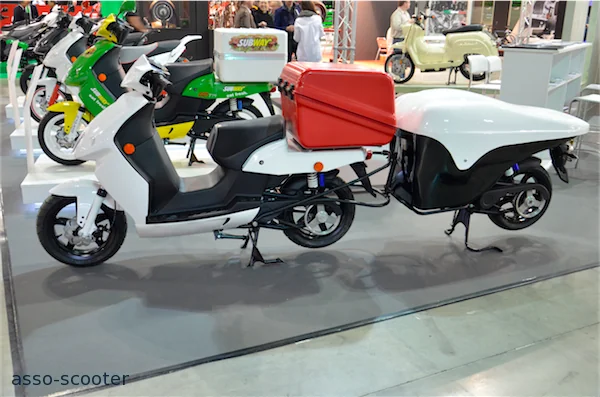
Article Complete Info
| Articleid | 394758 |
|---|---|
| Category | Scooter |
| Make | Govecs |
| Model | GO T 3.4 |
| Year | 2014 |
Chassis, Suspension, Brakes & Wheels
| Frametype | Steel |
|---|---|
| Frontbrakes | Single disc. Hydraulic |
| Frontsuspension | Telescopic fork |
| Fronttyre | 130/60-R13 |
| Rearbrakes | Single disc. Hydraulic |
| Rearsuspension | Monoshock |
| Reartyre | 130/60-R13 |
Engine & Transmission
| Coolingsystem | Air |
|---|---|
| Emissiondetails | No emission |
| Enginedetails | Electric |
| Enginetype | Brushless motor |
| Gearbox | 1-speed |
| Topspeed | 80.0 km/h (49.7 mph) |
| Torque | 114.00 Nm (11.6 kgf-m or 84.1 ft.lbs) |
| Transmissiontypefinaldrive | Belt |
Other Specifications
| Carryingcapacity | Top box. Up to 200 litre capacity. |
|---|---|
| Comments | Panasonic Lithium 72V battery. Charging time 4-5 hours. Approx. 2 hours to 80% charging. Range 50-70 km. A plus version is availble with a top speed of 62 km/h. |
| Factorywarranty | 24 months |
| Starter | Electric |
Physical Measures & Capacities
| Dryweight | 115.0 kg (253.5 pounds) |
|---|---|
| Seatheight | 790 mm (31.1 inches) If adjustable, lowest setting. |
About Govecs
Country of Origin:
Germany
Founder:
Thomas Grübel and team (GOVECS GmbH)
Best Known For:
Fleet-grade electric scooters (GO! series) for delivery and sharing
Company History
Munich-based Govecs approached electric scooters with an engineer’s sobriety: build durable, telematics-ready vehicles that survive fleet punishment and European weather. The GO! series focused on hub-motor simplicity, removable or modular batteries, and service access that keeps workshop time low. Govecs supplied large delivery firms and sharing operators, which forced rapid iteration on pack longevity, controller cooling, and waterproofing—lessons that bled into private-owner models. The company’s documentation, parts logistics, and training programs earned trust from operators who measure cost per kilometer obsessively. As cities tightened emissions and noise rules, Govecs was well placed to expand, adding ABS/combined braking and safety features while maintaining predictable range. Historically, Govecs is part of Europe’s first serious wave of e-two-wheelers that proved EVs could be tools, not toys. It helped set procurement expectations—realistic range, spare batteries on the shelf, and dashboards that report health honestly—shaping how fleets think about electrification beyond cars.