
2004
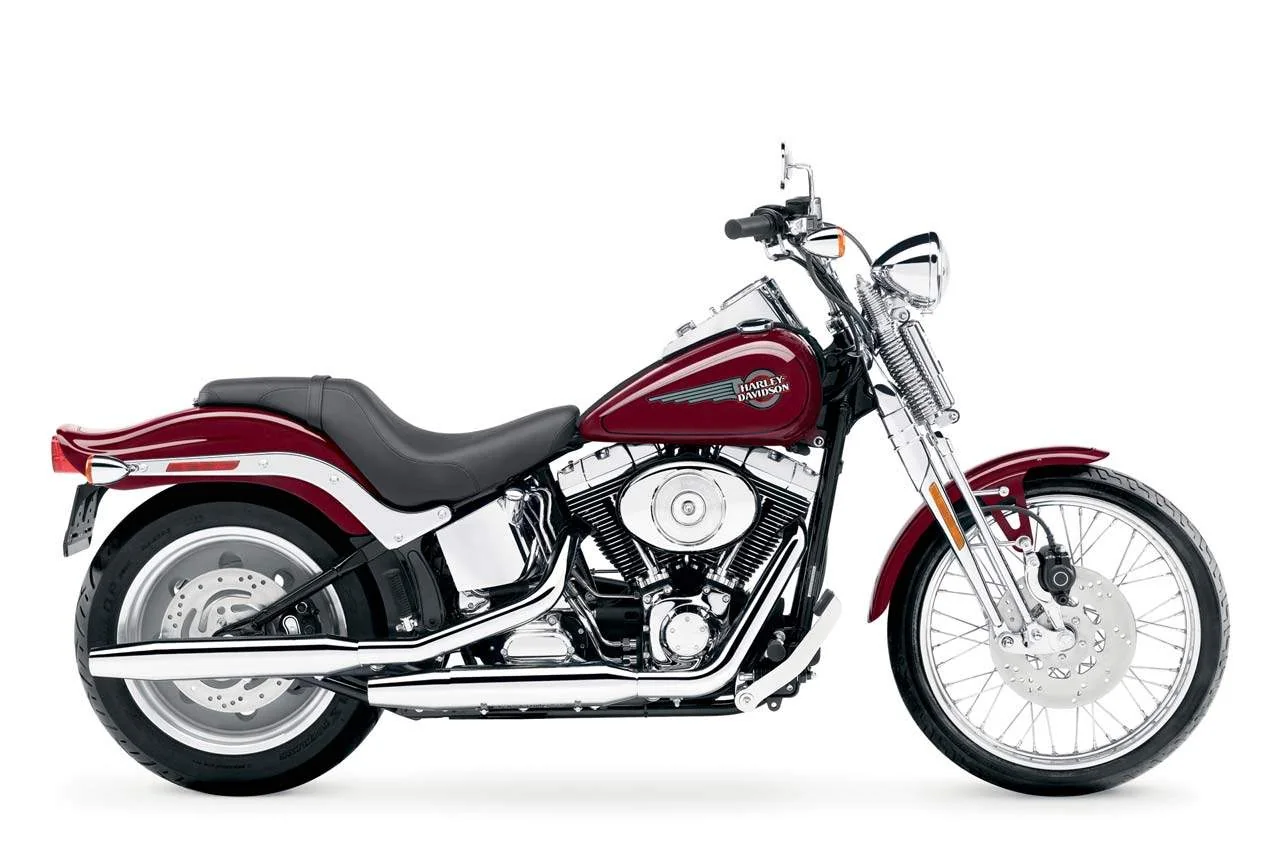
Harley-Davidson FXSTSI Springer Softail - Specifications & Review
Article Complete Info
| Articleid | 693954 |
|---|---|
| Category | Custom-cruiser |
| Make | Harley-Davidson |
| Model | FXSTSI Springer Softail |
| Year | 2004 |
Chassis, Suspension, Brakes & Wheels
| Frontbrakes | Single disc |
|---|---|
| Frontbrakesdiameter | 292 mm (11.5 inches) |
| Fronttyre | 90/90-21 |
| Rake | 32.0° |
| Rearbrakes | Single disc |
| Rearbrakesdiameter | 292 mm (11.5 inches) |
| Reartyre | 150/80-16 |
| Trail | 135 mm (5.3 inches) |
Engine & Transmission
| Borexstroke | 95.3 x 101.6 mm (3.8 x 4.0 inches) |
|---|---|
| Compression | 8.8:1 |
| Coolingsystem | Air |
| Displacement | 1449.00 ccm (88.42 cubic inches) |
| Enginedetails | V2, four-stroke |
| Fuelsystem | Injection |
| Gearbox | 5-speed |
| Torque | 102.00 Nm (10.4 kgf-m or 75.2 ft.lbs) @ 3500 RPM |
| Transmissiontypefinaldrive | Belt |
| Valvespercylinder | 2 |
Other Specifications
| Coloroptions | Vivid black, sierra red, impact blue, luxury blue, lava red sunglo, two-tone impact blue and vivid black, two-tone luxury teal and brilliant silver |
|---|---|
| Comments | Black powder-coated engine with chrome covers; chrome Springer front forks; Badlander style seat; chrome tank console, rear fender supports, air cleaner, and oil tank; new low-rise handlebars; bobtail fender |
Physical Measures & Capacities
| Dryweight | 302.0 kg (665.8 pounds) |
|---|---|
| Fuelcapacity | 18.90 litres (4.99 gallons) |
| Groundclearance | 137 mm (5.4 inches) |
| Overalllength | 2,375 mm (93.5 inches) |
| Seatheight | 640 mm (25.2 inches) If adjustable, lowest setting. |
About Harley-Davidson
Country of Origin:
United States
Founder:
William S. Harley, Arthur Davidson, Walter Davidson, William A. Davidson
Best Known For:
V-twin cruisers, touring icons, H-D culture; also LiveWire electric spinoff
Company History
Founded in Milwaukee in 1903, Harley-Davidson grew from backyard shed to global symbol. Early board-trackers and military machines proved durability; postwar big twins defined American road culture with a cadence and silhouette that became shorthand for freedom. The company professionalized long-distance comfort—Electra Glide fairings, air shocks, and later sophisticated infotainment—while keeping a mechanical identity built on a 45° V-twin heartbeat. Harley also navigated reinvention: the Evolution engine restored reliability in the 1980s; rubber mounting tamed vibes; and fuel injection, ABS, and ride-by-wire brought modernity. The brand’s culture—H.O.G. rides, dealer events, customization—turns ownership into community. Recent decades saw expansion into liquid-cooled performance (Revolution X) and true adventure/sport segments (Pan America, Sportster S), while LiveWire broke ground in electric motorcycling. Historically, Harley’s significance extends beyond machines: it’s a maker of rituals and myth, exporting an American idea of the open road. The tension between heritage and innovation defines each new model year, but the throughline is tactile connection—torque-rich roll-on, slow idle, and a sense that the bike has a pulse.