
2003
Highland 950 V2 Outback - Specifications & Review
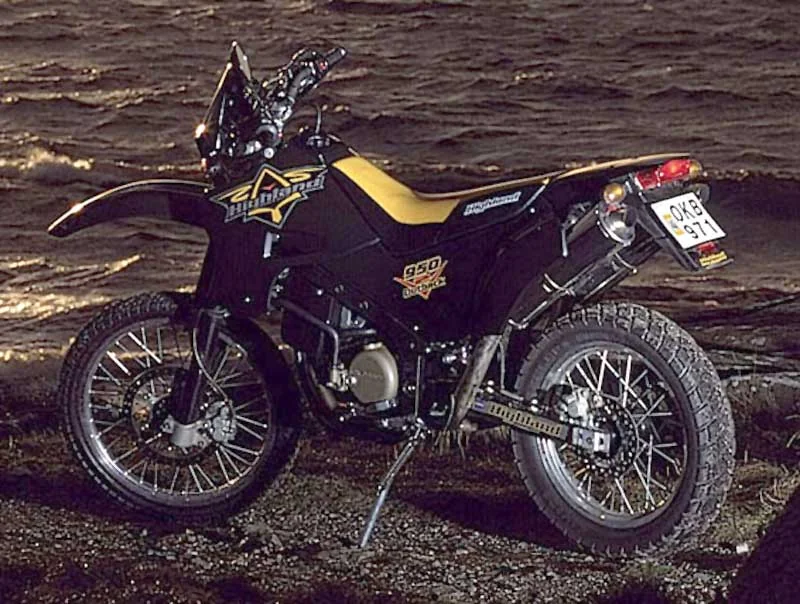
Article Complete Info
| Articleid | 162440 |
|---|---|
| Category | Enduro-offroad |
| Make | Highland |
| Model | 950 V2 Outback |
| Year | 2003 |
Chassis, Suspension, Brakes & Wheels
| Frametype | CrMo steel |
|---|---|
| Frontbrakes | Brembo twin caliper |
| Frontbrakesdiameter | 300 mm (11.8 inches) |
| Frontsuspension | 50 mm WP, adjustable compression and rebound |
| Frontwheeltravel | 280 mm (11.0 inches) |
| Rearbrakes | Brembo single caliper |
| Rearbrakesdiameter | 220 mm (8.7 inches) |
| Rearsuspension | WP, adjustable stiffness, compression and rebound |
| Rearwheeltravel | 300 mm (11.8 inches) |
Engine & Transmission
| Borexstroke | 95.0 x 66.0 mm (3.7 x 2.6 inches) |
|---|---|
| Coolingsystem | Liquid |
| Displacement | 950.00 ccm (57.97 cubic inches) |
| Enginedetails | V2, four-stroke |
| Fuelsystem | Injection |
| Gearbox | 6-speed |
| Power | 85.00 HP (62.0 kW)) @ 6000 RPM |
| Torque | 103.00 Nm (10.5 kgf-m or 76.0 ft.lbs) @ 4600 RPM |
| Transmissiontypefinaldrive | Chain |
| Valvespercylinder | 4 |
Physical Measures & Capacities
| Dryweight | 165.0 kg (363.8 pounds) |
|---|---|
| Fuelcapacity | 20.00 litres (5.28 gallons) |
| Groundclearance | 300 mm (11.8 inches) |
| Powerweightratio | 0.5152 HP/kg |
| Seatheight | 910 mm (35.8 inches) If adjustable, lowest setting. |
About Highland
Country of Origin:
Sweden (later U.S. assembly attempts)
Founder:
Mats Malmberg and a team of Swedish engineers
Best Known For:
Featherweight, high-performance four-stroke enduro/supermoto twins and singles
Company History
Highland emerged in the 1990s with a bold Scandinavian take on performance off-road: compact, punchy engines in minimal chassis that prioritized mass centralization and service access. Early 950/1000 V-twin concepts and 450/570 singles earned attention for startling power-to-weight and crisp throttle response. The bikes felt like prototypes you could buy—raw, immediate, and thrilling—at a time when many OEMs grew heavier. Tragically, leadership losses and business turbulence hampered continuity, and attempts to relaunch production in the U.S. struggled against homologation costs and capital demands. Yet testers consistently praised Highland’s dynamics: supple suspension that stayed high in the stroke, geometry that rewarded committed inputs, and engines that pulled like oversized electrics. Historically, Highland stands with Britten and Bimota in the canon of small teams punching above their weight through clear ideas and superb metalwork. The rarity of surviving bikes only sharpens their legend: glimpses of an alternate path where Scandinavian minimalism defined the fast-dirt playbook years before the weight wars truly began.