
1985
Honda CB 650 SC - Specifications & Review
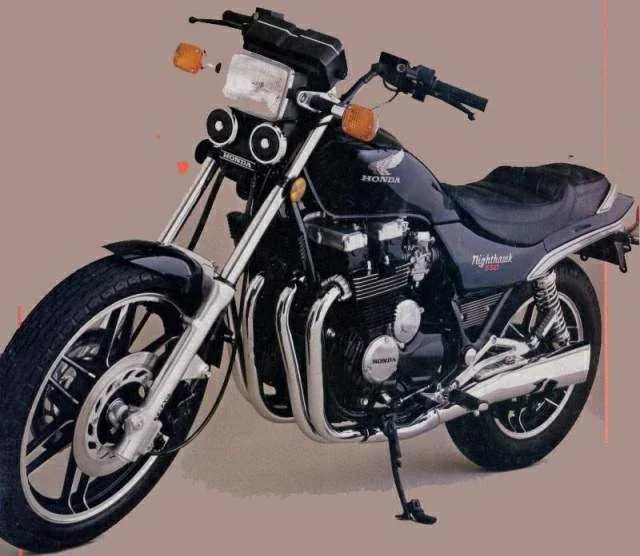
Article Complete Info
| Articleid | 889316 |
|---|---|
| Category | Classic |
| Make | Honda |
| Model | CB 650 SC |
| Year | 1985 |
Chassis, Suspension, Brakes & Wheels
| Frontbrakes | Double disc. Dual-disc with twin-piston calipers |
|---|---|
| Frontsuspension | 39mm air-adjustable leading-axle forks with dual Syntallic bushings and TRAC |
| Fronttyre | 100/90-19 |
| Rearbrakes | Expanding brake (drum brake). Drum |
| Rearsuspension | VHD shocks with four-way adjustable rebound damping |
| Reartyre | 130/90-16 |
| Wheels | Cast Alloy |
Engine & Transmission
| Borexstroke | 60.0 x 58.0 mm (2.4 x 2.3 inches) |
|---|---|
| Clutch | Wet |
| Compression | 9.5:1 |
| Coolingsystem | Oil & air |
| Displacement | 655.00 ccm (39.97 cubic inches) |
| Enginedetails | In-line four, four-stroke |
| Enginetype | 655cc transverse in-line four-cylinder |
| Exhaustsystem | Four into two with chrome pipes |
| Fuelconsumption | 6.19 litres/100 km (16.2 km/l or 38.00 mpg) |
| Fuelsystem | Carburettor. Four 32mm diaphragm-type CV |
| Gearbox | 6-speed |
| Greenhousegases | 143.6 CO2 g/km. (CO2 - Carbon dioxide emission) |
| Ignition | solid state |
| Maxrpm | 10000 |
| Topspeed | 233.4 km/h (145.0 mph) |
| Transmissiontypefinaldrive | Shaft drive (cardan) |
| Valvespercylinder | 4 |
Other Specifications
| Coloroptions | Red, blue |
|---|---|
| Instruments | LCD fuel gauge, LCD gear-position indicator, Electronic tachometer, Push-to-cancel turn signal switch |
| Light | 55/60-watt halogen headlight |
| Modificationscomparedtopreviousmodel | TRAC system. New style disc brake rotors. Redesigned instrument panel. New graphics. |
| Starter | Electric |
Physical Measures & Capacities
| Dryweight | 197.0 kg (434.4 pounds) |
|---|---|
| Fuelcapacity | 12.87 litres (3.40 gallons) |
| Reservefuelcapacity | 1.89 litres (0.50 gallons) |
| Seatheight | 790 mm (31.1 inches) If adjustable, lowest setting. |
About Honda
Country of Origin:
Japan
Founder:
Soichiro Honda (with Takeo Fujisawa as business architect)
Best Known For:
From Super Cub ubiquity to RC-era racing dominance; CB/CRF/Gold Wing families and bulletproof reliability
Company History
No marque has touched more riders than Honda. The Super Cub rewrote mobility—tens of millions built, step-through convenience, engines that survive astonishing neglect. Behind the charm sat ruthless engineering: metallurgy, tolerances, and manufacturing systems that made reliability a baseline, not a feature. Honda raced to learn: from Isle of Man to modern MotoGP, RC machines taught lessons in breathing, friction reduction, and chassis stiffness that flowed into streetbikes. The 1969 CB750 brought the superbike age; the Gold Wing defined long-distance civility; the Fireblade reinvented power-to-weight; and CR/CRF dirt bikes set standards for off-road agility. Corporate culture prized kaizen and respect for the user—controls that feel intuitive, parts support that keeps 1970s bikes alive, and engines that start after winters of silence. Honda also led in safety and emissions, pushing EFI, ABS, and catalytic solutions early and at scale. Historically, Honda democratized excellence: making the extraordinary ordinary so that a delivery rider in Delhi and a tourer in Denver share the same trust in their machines. The brand’s throughline is simple: engineer the friction out of ownership so the ride can take center stage.