
2022
Aprilia SX 50 Factory - Specifications & Review
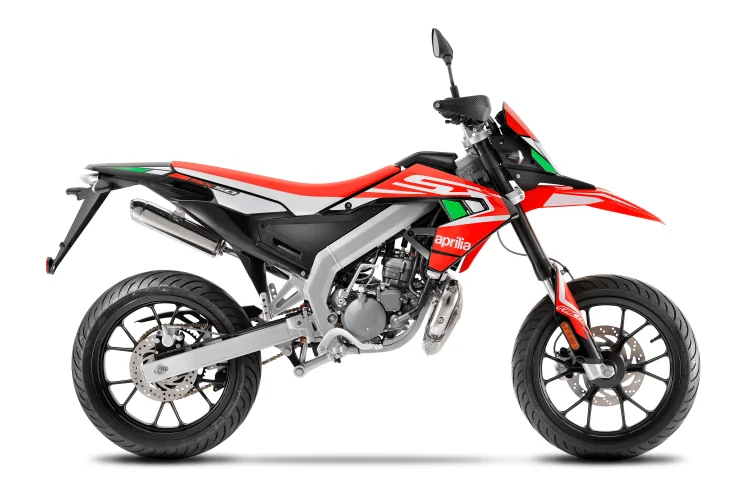
Article Complete Info
| Articleid | 220529 |
|---|---|
| Category | Super motard |
| Make | Aprilia |
| Model | SX 50 Factory |
| Year | 2022 |
Chassis, Suspension, Brakes & Wheels
| Frametype | Twin tube, steel |
|---|---|
| Frontbrakes | Single disc. Stainless steel disc with 2-piston floating calliper |
| Frontbrakesdiameter | 260 mm (10.2 inches) |
| Frontsuspension | Upside down fork with Ø 41 mm stanchions |
| Fronttyre | 100/80-17 |
| Frontwheeltravel | 170 mm (6.7 inches) |
| Rearbrakes | Single disc. Stainless steel disc with floating calliper |
| Rearbrakesdiameter | 260 mm (10.2 inches) |
| Rearsuspension | Aluminium swingarm. Hydraulic monoshock absorber with linkage. |
| Reartyre | 130/70-17 |
| Rearwheeltravel | 200 mm (7.9 inches) |
| Wheels | Lightweight alloy |
Engine & Transmission
| Borexstroke | 40.0 x 39.3 mm (1.6 x 1.5 inches) |
|---|---|
| Clutch | Wet multi-plate |
| Compression | 11.5:1 |
| Coolingsystem | Liquid |
| Displacement | 50.0 ccm (3.05 cubic inches) |
| Emissiondetails | Euro 4 |
| Enginetype | Single cylinder, two-stroke |
| Fuelconsumption | 3.14 litres/100 km (31.8 km/l or 74.91 mpg) |
| Fuelsystem | Carburettor. Electronically controlled Dell'Orto PHVA 17.5 carburettor |
| Gearbox | 6-speed |
| Greenhousegases | 72.8 CO2 g/km. (CO2 - Carbon dioxide emission) |
| Ignition | CDI |
| Lubricationsystem | Automatic mixer |
| Transmissiontypefinaldrive | Chain (final drive) |
Other Specifications
| Coloroptions | Red Boost |
|---|---|
| Starter | Kick |
Physical Measures & Capacities
| Fuelcapacity | 7.00 litres (1.85 US gallons) |
|---|---|
| Overallheight | 1120 mm (44.1 inches) |
| Overalllength | 2020 mm (79.5 inches) |
| Overallwidth | 830 mm (32.7 inches) |
| Seatheight | 860 mm (33.9 inches) If adjustable, lowest setting. |
| Weightincloilgasetc | 99.0 kg (218.3 pounds) |
About Aprilia
Country of Origin:
Italy
Founder:
Cavaliere Alberto Beggio (later led by Ivano Beggio)
Best Known For:
GP-winning two-strokes (RS125/250), RSV superbikes, and cutting-edge electronics
Company History
Aprilia started in Noale after WWII as a bicycle company before pivoting to mopeds and small-displacement motorcycles. Under Ivano Beggio in the 1970s–90s, Aprilia embraced racing as R&D, building fierce RS125/250 two-strokes that produced world champions and taught countless Europeans how a chassis should feel. The brand’s road lineup mirrored podium lessons: lightweight frames, sharp geometry, and brakes from the top shelf. With the RSV Mille, later RSV4, Aprilia brought V-twin then V-4 sophistication to superbikes, pairing compact engines with electronics that arrived early and matured fast—ride-by-wire, APRC traction/wheelie control, and track-calibrated ABS. The Tuono popularized the ‘supernaked’ formula, while the Shiver/Dorsoduro explored middleweight versatility. Scooter successes and the Caponord/Tuareg adventure lines broadened reach without surrendering the handling DNA. Aprilia’s factory in Noale retained a skunkworks spirit, where racing engineers and production teams traded ideas rapidly; the RS-GP MotoGP effort further refined aero and electronics that later influenced streetbikes. Historically, Aprilia matters because it democratized race feel: crisp steering, clear feedback, and tech that flatters riders rather than overwhelms them. Owners speak of precision—bikes that reward clean inputs and repay attention to tire pressures and setup. In the pantheon of Italian marques, Aprilia stands for modernity: less baroque drama, more lap-time logic, and an insistence that every model carry a little paddock in its genes.