
2024
Marine Turbine Technologies 420 RR - Specifications & Review
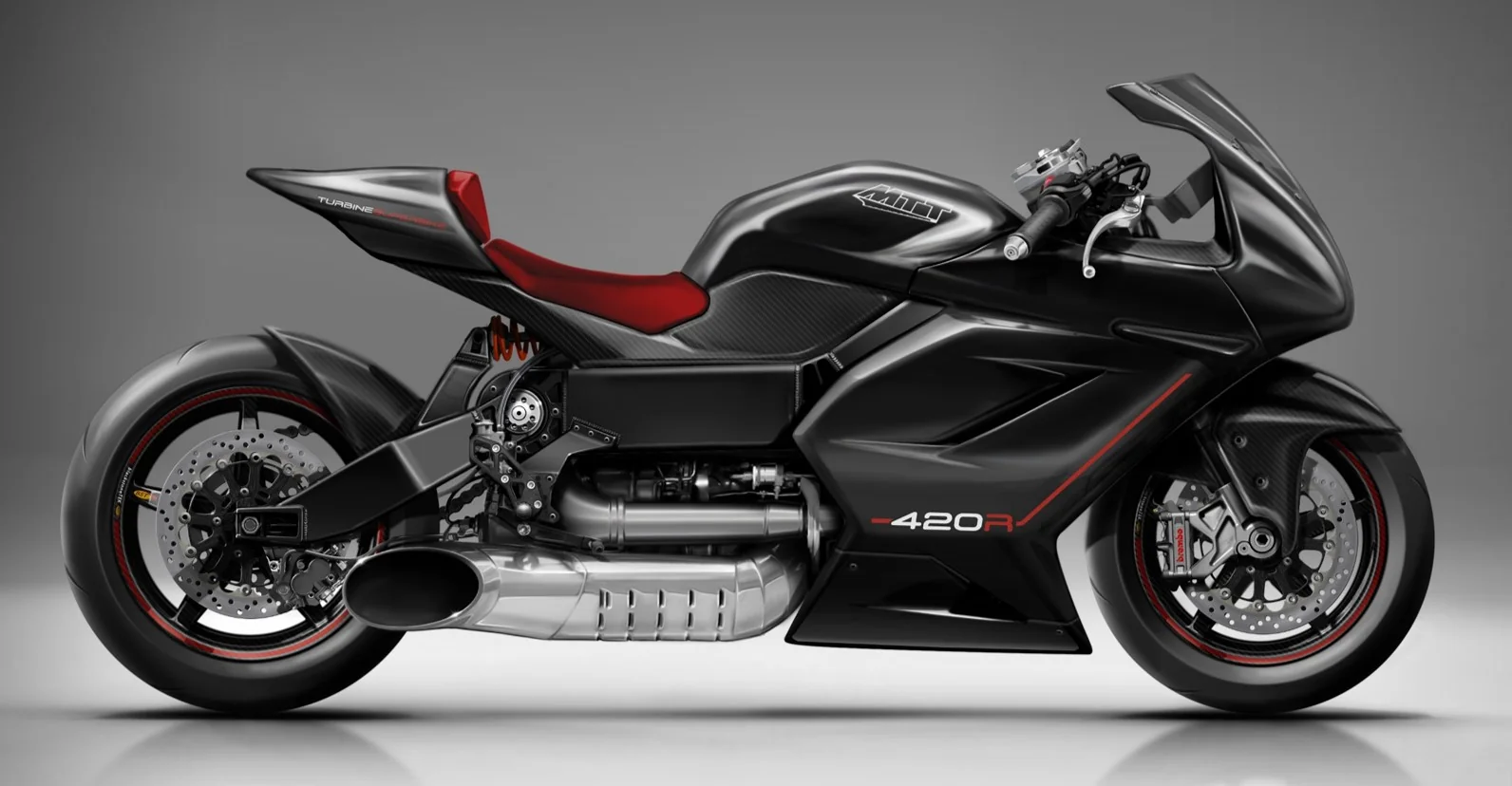
Article Complete Info
| Articleid | 906286 |
|---|---|
| Category | Sport |
| Make | Marine Turbine Technologies |
| Model | 420 RR |
| Year | 2024 |
Chassis, Suspension, Brakes & Wheels
| Frametype | Tubular aluminum alloy. |
|---|---|
| Frontbrakes | Double disc. Brembo, 4 piston calipers |
| Frontbrakesdiameter | 320 mm (12.6 inches) |
| Frontsuspension | Inverted fork, 55 mm |
| Fronttyre | 120/60-ZR17 |
| Rake | 27.0° |
| Rearbrakes | Single disc. Brembo, 4 piston calipers |
| Rearbrakesdiameter | 320 mm (12.6 inches) |
| Rearsuspension | Mono-shock adjustable, oleo-pneumatic, Ohlins |
| Reartyre | 200/50-ZR17 |
| Seat | Solo seat |
| Wheels | Pirelli tyres |
Engine & Transmission
| Driveline | 2-speed, automatic |
|---|---|
| Enginedetails | Rolls Royce Allison – 250-C20 Series Gas Turbine |
| Gearbox | 2-speed |
| Lubricationsystem | Dry-sump, 3.5-qts turbine oil |
| Topspeed | 439.4 km/h (273.0 mph) |
| Torque | 678.0 Nm (69.1 kgf-m or 500.1 ft.lbs) @ 2000 RPM |
| Transmissiontypefinaldrive | Chain (final drive) |
Other Specifications
| Coloroptions | Custom colors |
|---|---|
| Comments | Diesel and Kerosene fuel. Carbon fiber fairings. Windscreen. Model also called MTT 420 RR. US company. |
| Instruments | TFT colour display/analogue |
| Starter | Electric |
Physical Measures & Capacities
| Dryweight | 226.8 kg (500.0 pounds) |
|---|---|
| Fuelcapacity | 34.00 litres (8.98 US gallons) |
| Oilcapacity | 3.30 litres (3.49 US quarts) |
| Powerweightratio | 1.8519 HP/kg |
| Reservefuelcapacity | 6.00 litres (1.59 US gallons) |
| Seatheight | 800 mm (31.5 inches) If adjustable, lowest setting. |
About Marine Turbine Technologies
Country of Origin:
United States
Founder:
Ted McIntyre II (MTT)
Best Known For:
MTT Y2K turbine-powered motorcycle
Company History
MTT turned a jet helicopter turboshaft into the heart of a road-legal motorcycle, creating the Y2K—an engineering spectacle with turbine whine, surreal smoothness, and thrust that felt aviation-grade. The chassis, brakes, and heat management demanded serious design to tame extreme exhaust temperatures and deliver stable handling. Built in tiny numbers, each bike is effectively a hand-crafted prototype validated to live on public roads. While impractical for commuting, the Y2K opened imaginations: what happens when aerospace components meet motorcycle packaging? It also showcased American boutique fabrication at its wildest, from composite bodywork to meticulously routed plumbing. Historically, MTT’s Y2K joins Britten and Bimota in the pantheon of audacious engineering projects that expand the category’s boundaries. Most riders will never pilot one, but its influence is cultural—proof that the motorcycle can be both science project and sculpture, and that performance can arrive as a smooth turbine rush rather than piston pulses.