
2012
Mavizen TTX02 - Specifications & Review
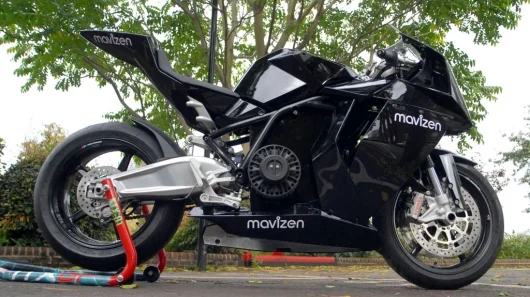
Article Complete Info
| Articleid | 123955 |
|---|---|
| Category | Sport |
| Make | Mavizen |
| Model | TTX02 |
| Year | 2012 |
Chassis, Suspension, Brakes & Wheels
| Frametype | Powder coated Chromium-Molybdenum trellis |
|---|---|
| Frontbrakes | Double disc |
| Frontsuspension | WP-USD, 43 mm |
| Fronttyre | 120/70-17 |
| Rake | 23.3° |
| Rearbrakes | Single disc |
| Rearsuspension | WP-Monoshock |
| Reartyre | 190/55-17 |
| Trail | 90 mm (3.5 inches) |
Engine & Transmission
| Coolingsystem | Air |
|---|---|
| Enginedetails | Electric |
| Enginetype | Twin DC Brushed Electric Motors. |
| Gearbox | 1-speed |
| Power | 100.00 HP (73.0 kW)) @ 5800 RPM |
| Topspeed | 210.0 km/h (130.5 mph) |
| Torque | 105.00 Nm (10.7 kgf-m or 77.4 ft.lbs) @ 5800 RPM |
| Transmissiontypefinaldrive | Chain |
| Zerotoonehundred | 5.000 seconds |
Other Specifications
| Coloroptions | Black |
|---|---|
| Comments | Swappable drivetrain and batteries at trackside. Charging time 4 hours. Integrated IP connectivity. Linux based. USB based system bus allows a virtually unlimited number of peripherals to extend the capabilities of the machine with plug’n’play. Remote factory support package available. |
| Electrical | 96V 7.5 kWh Lithium Polymer Battery Pack. Charge time: 4 hours. |
| Instruments | Touch screen user interface and on board PC that is integrated into the bike´s electronics. |
| Starter | Electric |
Physical Measures & Capacities
| Dryweight | 115.0 kg (253.5 pounds) |
|---|---|
| Groundclearance | 110 mm (4.3 inches) |
| Powerweightratio | 0.8696 HP/kg |
| Seatheight | 805 mm (31.7 inches) If adjustable, lowest setting. |
| Weightincloilgasetc | 170.0 kg (374.8 pounds) |
About Mavizen
Country of Origin:
United Kingdom
Founder:
Azhar Hussain (TTXGP founder)
Best Known For:
Early electric race bike platforms/parts supporting TTXGP and e-road racing
Company History
Mavizen supplied chassis, drivetrains, and know-how to early EV race teams at a time when electric motorcycles were more idea than ecosystem. By packaging motors, controllers, and batteries into adaptable platforms with documentation and spares, Mavizen lowered barriers for privateers to compete in TTXGP and other pioneering series. The work emphasized thermal management, wiring integrity, and software calibration—lessons that later shaped mainstream EV design. Though volumes were tiny and the brand’s public presence brief, its impact was catalytic: standardizing components and expectations so races could be decided by riders and strategy, not teething failures. Historically, Mavizen belongs to motorsport’s skunkworks lineage—entities that make a new category viable by providing shared tools. Many of today’s electric teams trace their processes to those first seasons, when Mavizen kits and advice kept bikes finishing laps and data flowing.