
2009
MZ 1000 ST SuperTraveller - Specifications & Review
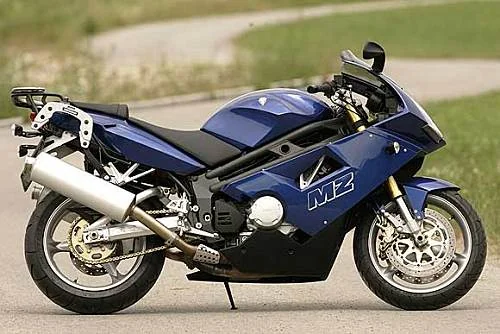
Article Complete Info
| Articleid | 738964 |
|---|---|
| Category | Sport touring |
| Make | MZ |
| Model | 1000 ST SuperTraveller |
| Year | 2009 |
Chassis, Suspension, Brakes & Wheels
| Frametype | Dual tube bridge frame |
|---|---|
| Frontbrakes | Double disc. 4-piston calipers |
| Frontbrakesdiameter | 320 mm (12.6 inches) |
| Frontsuspension | Upside-down fork / central suspension strut |
| Fronttyre | 120/70-ZR17 |
| Rearbrakes | Single disc |
| Rearbrakesdiameter | 243 mm (9.6 inches) |
| Rearsuspension | Monoshock |
| Reartyre | 180/55-ZR17 |
Engine & Transmission
| Borexstroke | 96.0 x 69.0 mm (3.8 x 2.7 inches) |
|---|---|
| Compression | 11.5:1 |
| Coolingsystem | Liquid |
| Displacement | 999.00 ccm (60.96 cubic inches) |
| Enginedetails | Twin, four-stroke |
| Exhaustsystem | Closed-loop 3-way catalytic converter |
| Fuelsystem | Injection. Indirect multipoint electronic injection |
| Gearbox | 6-speed |
| Power | 111.30 HP (81.2 kW)) @ 9000 RPM |
| Torque | 98.00 Nm (10.0 kgf-m or 72.3 ft.lbs) @ 7000 RPM |
| Transmissiontypefinaldrive | Chain |
| Valvespercylinder | 4 |
Other Specifications
| Coloroptions | Blue/white |
|---|---|
| Starter | Electric |
Physical Measures & Capacities
| Dryweight | 210.0 kg (463.0 pounds) |
|---|---|
| Fuelcapacity | 20.00 litres (5.28 gallons) |
| Powerweightratio | 0.5300 HP/kg |
| Reservefuelcapacity | 5.00 litres (1.32 gallons) |
| Seatheight | 820 mm (32.3 inches) If adjustable, lowest setting. |
About MZ
Country of Origin:
Germany (formerly East Germany)
Founder:
Originally DKW Zschopau; later VEB Motorradwerk Zschopau (MZ)
Best Known For:
Rugged commuters and ISDT/GP two-strokes; affordable mobility across the Eastern Bloc
Company History
MZ evolved from DKW’s Zschopau works into the state-run East German manufacturer that motorized much of the Eastern Bloc. Its two-stroke singles and twins were honest tools—oil-bath chains, simple electrics, and engines that would restart after a winter under snow. In sport, MZ’s engineers, including two-stroke visionary Walter Kaaden, advanced expansion-chamber science and delivered startling racing performance despite political headwinds and limited resources. On the street, ES/TS/ETZ families carried workers and families for decades, their appeal rooted in fixability and a spares culture that turned backyard sheds into viable workshops. After reunification, the brand pursued modern products (often as MuZ) around Japanese singles, producing underrated gems before financial reality intervened. Historically, MZ stands for transport as infrastructure—machines that kept lives moving—and for ingenuity under constraint. The surviving bikes are living classrooms in mechanical clarity and the virtues of lightweight, tractable power.