
2012
Piaggio MP3 Touring 300 - Specifications & Review
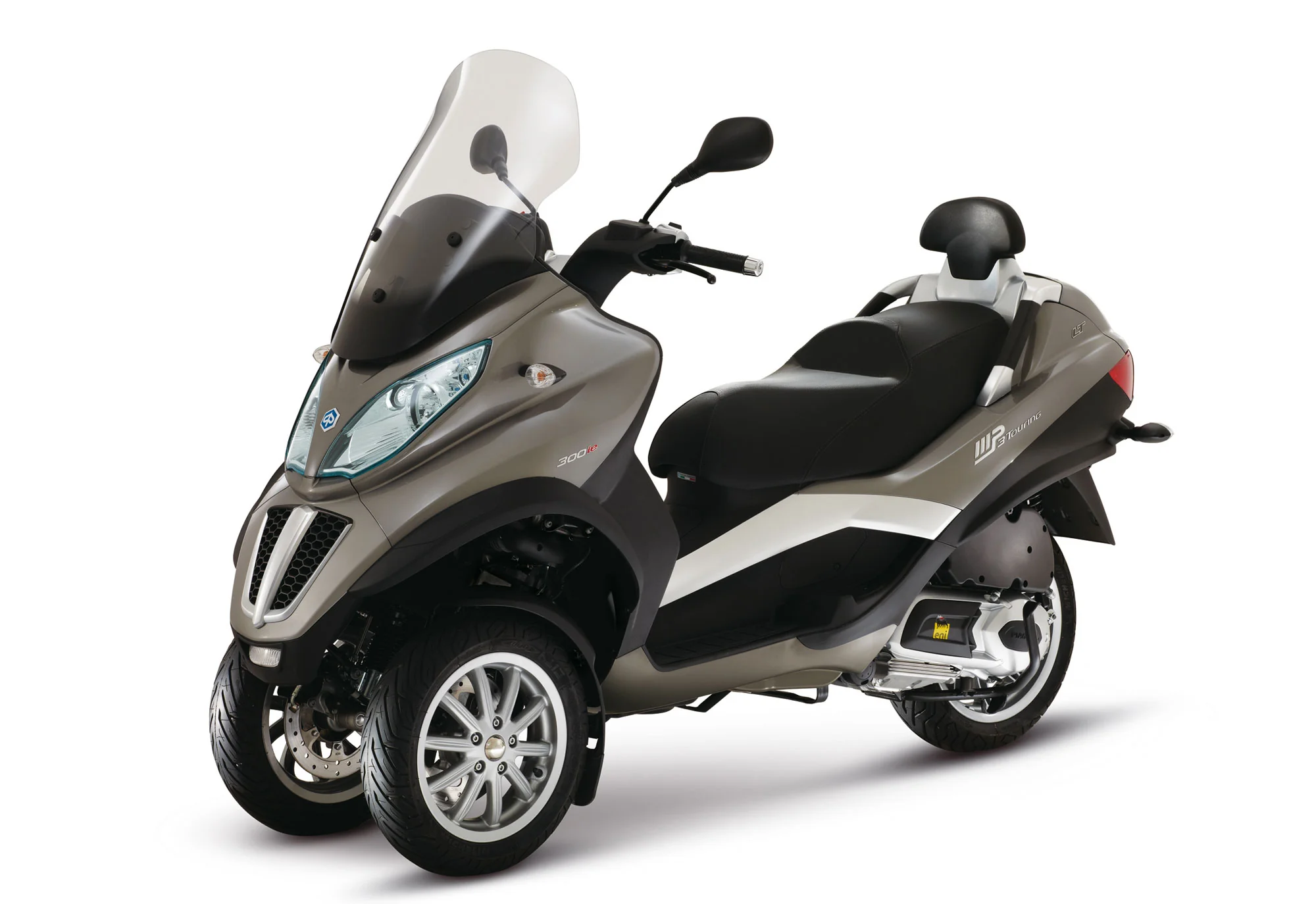
Article Complete Info
| Articleid | 550991 |
|---|---|
| Category | Scooter |
| Make | Piaggio |
| Model | MP3 Touring 300 |
| Year | 2012 |
Chassis, Suspension, Brakes & Wheels
| Frametype | Double cradle in high strength tubular steel |
|---|---|
| Frontbrakes | Double disc |
| Frontbrakesdiameter | 240 mm (9.4 inches) |
| Frontsuspension | Tilting parallelogram with 4 arms supporting 2 steering tubes. |
| Fronttyre | 120/70-12 |
| Rearbrakes | Single disc |
| Rearbrakesdiameter | 240 mm (9.4 inches) |
| Rearsuspension | 2 double acting hydraulic shock absorbers |
| Reartyre | 140/70-14 |
| Wheels | Aluminium alloy |
Engine & Transmission
| Borexstroke | 75.0 x 63.0 mm (3.0 x 2.5 inches) |
|---|---|
| Coolingsystem | Liquid |
| Displacement | 278.00 ccm (16.96 cubic inches) |
| Driveline | CVT with torque server |
| Emissiondetails | Euro 3 |
| Enginedetails | Single cylinder, four-stroke |
| Fuelsystem | Injection |
| Gearbox | Automatic |
| Lubricationsystem | Wet sump |
| Power | 30.17 HP (22.0 kW)) @ 7500 RPM |
| Topspeed | 125.0 km/h (77.7 mph) |
| Torque | 23.50 Nm (2.4 kgf-m or 17.3 ft.lbs) @ 6500 RPM |
| Transmissiontypefinaldrive | Belt |
| Valvespercylinder | 4 |
Other Specifications
| Comments | Two front wheels. Windscreen. |
|---|---|
| Starter | Electric |
Physical Measures & Capacities
| Fuelcapacity | 12.00 litres (3.17 gallons) |
|---|---|
| Overallheight | 1,350 mm (53.1 inches) |
| Overalllength | 2,130 mm (83.9 inches) |
| Overallwidth | 745 mm (29.3 inches) |
| Seatheight | 780 mm (30.7 inches) If adjustable, lowest setting. |
| Weightincloilgasetc | 236.0 kg (520.3 pounds) |
About Piaggio
Country of Origin:
Italy
Founder:
Rinaldo Piaggio (later Vespa by Corradino D’Ascanio’s design)
Best Known For:
Vespa scooters; later umbrella for Aprilia, Moto Guzzi, and more
Company History
Piaggio pivoted from rail and aeronautics to postwar mobility with the Vespa, a steel-bodied icon that made personal transport elegant and gender-neutral. Protective bodywork, step-through ergonomics, and reliable engines turned the scooter into a social transformer across Europe and beyond. Over decades, Piaggio refined two-strokes into clean four-strokes, added modern electronics and ABS, and expanded body styles from classic Primavera to sporty GTS. As a group, Piaggio also stewarded storied marques like Aprilia and Moto Guzzi, leveraging scale while letting brands keep identity. Historically, Piaggio is both a product and a platform: it defined the scooter as a cultural object, then built an industrial network that sustains diverse two-wheel passions under one roof.