
2011
Polini 911 GP5 Reverse 50 - Specifications & Review
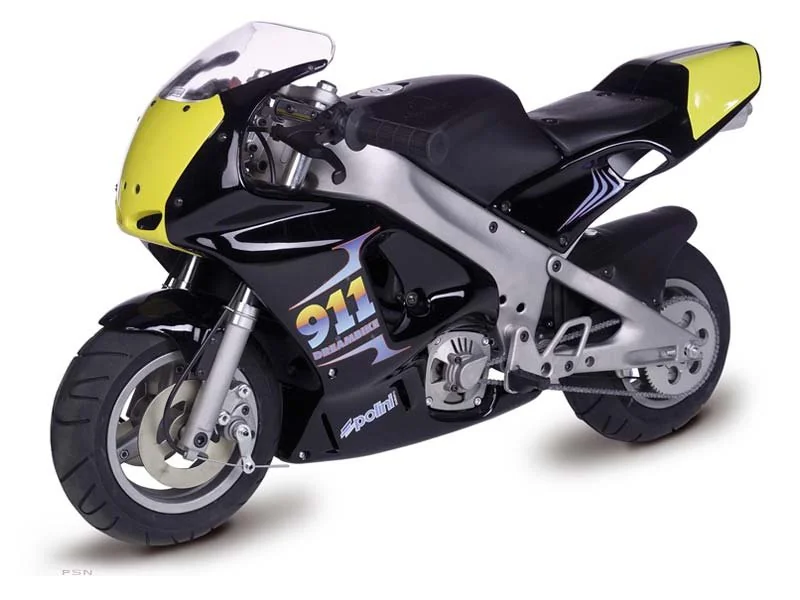
Article Complete Info
| Articleid | 298719 |
|---|---|
| Category | Minibike-sport |
| Make | Polini |
| Model | 911 GP5 Reverse 50 |
| Year | 2011 |
Chassis, Suspension, Brakes & Wheels
| Frametype | Latticed tubular frame |
|---|---|
| Frontbrakes | Single disc |
| Frontbrakesdiameter | 148 mm (5.8 inches) |
| Frontsuspension | Telescopic fork |
| Fronttyre | 90/65-R6.5 |
| Rearbrakes | Single disc |
| Rearbrakesdiameter | 130 mm (5.1 inches) |
| Rearsuspension | Swing Arm |
| Reartyre | 110/50-R6.5 |
Engine & Transmission
| Borexstroke | 40.0 x 39.0 mm (1.6 x 1.5 inches) |
|---|---|
| Clutch | Dry centrifugal |
| Compression | 16.5:1 |
| Coolingsystem | Air |
| Displacement | 49.30 ccm (3.01 cubic inches) |
| Enginedetails | Single cylinder, two-stroke |
| Enginetype | Aluminium cylinder |
| Fuelsystem | Carburettor. PHGB 19, reed valve in the crankcase |
| Lubricationsystem | 2% mixture |
| Transmissiontypefinaldrive | Chain |
Other Specifications
| Coloroptions | Blue/white |
|---|---|
| Comments | Italian minbikes for competiton-sports usage only. Pull start with self winding cable. |
| Light | No lights |
Physical Measures & Capacities
| Dryweight | 20.5 kg (45.2 pounds) |
|---|---|
| Fuelcapacity | 1.50 litres (0.40 gallons) |
| Overalllength | 1,160 mm (45.7 inches) |
| Overallwidth | 240 mm (9.4 inches) |
| Seatheight | 460 mm (18.1 inches) If adjustable, lowest setting. |
About Polini
Country of Origin:
Italy
Founder:
Battista Polini
Best Known For:
Tuning parts for scooters/minis (cylinders, variators, carbs) and minibikes
Company History
Polini is to small engines what big tuners are to superbikes: a byword for go-faster parts that work. From cylinders and variators to carbs and clutches, Polini kits help commuters and racers extract honest performance and reliability from 50–200 cc scooters and minis. The company also fields racing programs that feed development back into catalog parts, ensuring jetting tables, belt specs, and roller weights are grounded in track data. For decades, European teens learned mechanics through Polini—measuring squish, reading plugs, and feeling the difference a few grams of variator roller can make. Historically, Polini democratized performance, turning ordinary city runabouts into lively machines and seeding a culture of hands-on tuning that still thrives.