
2011
WT Motors Alaska WT500 - Specifications & Review
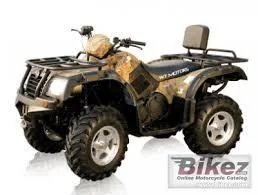
Article Complete Info
| Articleid | 31203 |
|---|---|
| Category | ATV |
| Make | WT Motors |
| Model | Alaska WT500 |
| Year | 2011 |
Chassis, Suspension, Brakes & Wheels
| Frontbrakes | Double disc |
|---|---|
| Frontsuspension | Independet A-arm |
| Fronttyre | 25/8-12 |
| Rearbrakes | Single disc |
| Rearsuspension | Independet A-arm |
| Reartyre | 25/10-12 |
Engine & Transmission
| Borexstroke | 87.5 x 82.0 mm (3.4 x 3.2 inches) |
|---|---|
| Clutch | Automtaic centrifugal |
| Compression | 10.2:1 |
| Coolingsystem | Liquid |
| Displacement | 493.00 ccm (30.08 cubic inches) |
| Driveline | 4WD |
| Enginedetails | Single cylinder, four-stroke |
| Fuelsystem | Carburettor. Mikuni |
| Gearbox | Automatic |
| Power | 19.44 HP (14.2 kW)) @ 6000 RPM |
| Torque | 30.00 Nm (3.1 kgf-m or 22.1 ft.lbs) @ 4500 RPM |
| Transmissiontypefinaldrive | Belt |
Other Specifications
| Coloroptions | Camouflage |
|---|---|
| Comments | A version with 200 mm extended seat height is available. Weight is 338 kg. The versions are called Passo Corto and Passo Lungo. Sold in Italy. |
| Electrical | 12 Volt 10 Ah battery |
| Light | Dual front lights |
| Starter | Electric & kick |
Physical Measures & Capacities
| Dryweight | 335.0 kg (738.5 pounds) |
|---|---|
| Fuelcapacity | 19.00 litres (5.02 gallons) |
| Oilcapacity | 2.00 litres (0.13 quarts) |
| Overallheight | 1,230 mm (48.4 inches) |
| Overalllength | 2,185 mm (86.0 inches) |
| Overallwidth | 1,170 mm (46.1 inches) |
| Powerweightratio | 0.0580 HP/kg |
About WT Motors
Country of Origin:
Italy (brand); manufacturing via Europe/Asia
Founder:
WT Motors (import/distribution entity)
Best Known For:
Scooters and light motorcycles curated for EU markets
Company History
WT Motors functioned as a curator, pairing reliable global platforms with European compliance and trim aimed at commuters: decent brakes, weather-proof electrics, and clear manuals. By focusing on parts stocking and service relationships, the brand turned value machinery into dependable daily tools. Its role underscores how much of motorcycling’s success depends on logistics and support—getting spares to riders and keeping simple transport simple.