
2010
Bimota DB6R - Specifications & Review
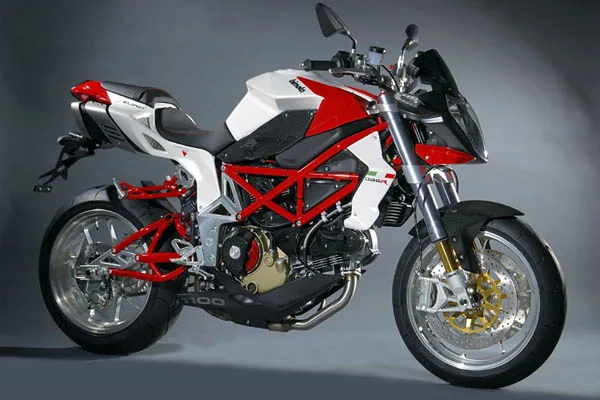
Article Complete Info
| Articleid | 105044 |
|---|---|
| Category | Sport |
| Make | Bimota |
| Model | DB6R |
| Year | 2010 |
Chassis, Suspension, Brakes & Wheels
| Frontbrakes | Double disc. Bremo |
|---|---|
| Frontbrakesdiameter | 320 mm (12.6 inches) |
| Frontsuspension | 50 mm Marzocchi UD fork TiN fully adjustable |
| Fronttyre | 120/70-ZR17 |
| Frontwheeltravel | 120 mm (4.7 inches) |
| Rake | 24.0° |
| Rearbrakes | Single disc. bremo |
| Rearbrakesdiameter | 220 mm (8.7 inches) |
| Rearsuspension | Extreme Tech Monoshock fully adjustable, compression low/high speed |
| Reartyre | 180/70-ZR17 |
| Rearwheeltravel | 120 mm (4.7 inches) |
Engine & Transmission
| Borexstroke | 98.0 x 71.5 mm (3.9 x 2.8 inches) |
|---|---|
| Clutch | Dry clutch Multi-disc with hydraulic actuation system |
| Compression | 10.5:1 |
| Coolingsystem | Air |
| Displacement | 1079.00 ccm (65.84 cubic inches) |
| Enginedetails | V2, four-stroke |
| Exhaustsystem | 2 in 1 in 2, inox steel |
| Fuelsystem | Injection. Walbro |
| Gearbox | 6-speed |
| Lubricationsystem | Wet sump |
| Maxrpm | 8500 |
| Transmissiontypefinaldrive | Chain |
| Valvespercylinder | 2 |
Other Specifications
| Coloroptions | Red/white |
|---|---|
| Comments | Ducati DS1100 engine. |
Physical Measures & Capacities
| Dryweight | 170.0 kg (374.8 pounds) |
|---|---|
| Fuelcapacity | 16.00 litres (4.23 gallons) |
| Groundclearance | 175 mm (6.9 inches) |
| Overalllength | 2,045 mm (80.5 inches) |
| Overallwidth | 830 mm (32.7 inches) |
| Seatheight | 820 mm (32.3 inches) If adjustable, lowest setting. |
About Bimota
Country of Origin:
Italy
Founder:
Valerio Bianchi, Giuseppe Morri, Massimo Tamburini
Best Known For:
Exotic chassis around big-brand engines (DB, SB, YB series); artisanal performance
Company History
Bimota began in Rimini as a chassis artisan, creating lightweight, exquisitely engineered frames to harness engines from Ducati, Suzuki, Yamaha, and others. Early masterpieces like the KB1/YB series set handling benchmarks when OEM frames flexed and wobbled, while later DB models distilled Italian twin character into scalpel-like precision. The bikes were expensive and often temperamental, but the payoff was extraordinary feel: steering that read tarmac texture, brakes matched to mass, and ergonomics that made committed riding natural. Bimota’s story also includes bold experiments—the hub-center Tesi with its alternative front end, and boutique production that rose and fell with economic tides. Through ownership changes and revivals, the brand’s essence remained the pursuit of dynamic purity through craftsmanship: beautifully machined parts, carbon layups, and assemblies that looked like jewelry even before they turned a wheel. Historically, Bimota gave the industry permission to treat the chassis as art and science in equal measure. For riders, a good Bimota is unforgettable—not because of peak power, but because of how intimately it translates thought into line.