
2021
Boom Trikes Mustang II - Specifications & Review
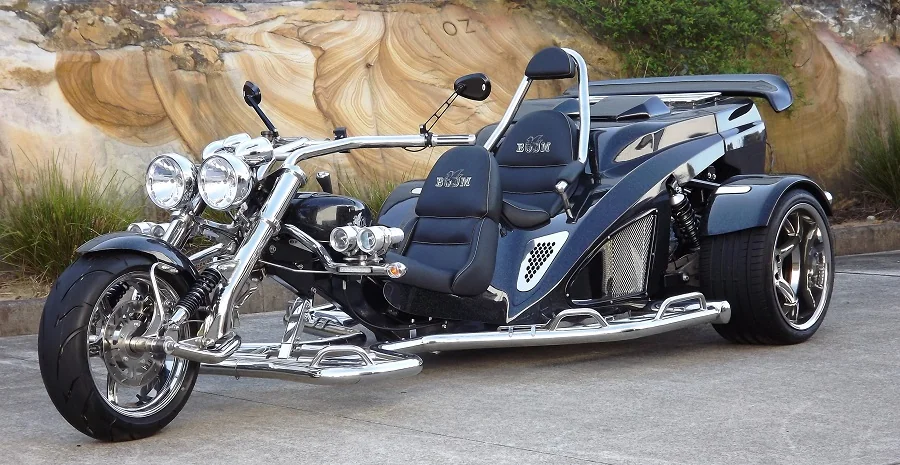
Article Complete Info
| Articleid | 374303 |
|---|---|
| Category | Custom-cruiser |
| Make | Boom Trikes |
| Model | Mustang II |
| Year | 2021 |
Chassis, Suspension, Brakes & Wheels
| Frametype | 2-parted tubular frame, bolted |
|---|---|
| Frontbrakes | Single disc |
| Frontsuspension | Polished stainless steel fork |
| Fronttyre | 170/60-17 |
| Rearbrakes | Single disc |
| Rearsuspension | Alloy semi trailing link axle with adjustable suspension. Koni adjustable suspension, standard. |
| Reartyre | 295/50-15 |
| Seat | 2 seats |
| Wheels | Chromium alloy rims |
Engine & Transmission
| Coolingsystem | Liquid |
|---|---|
| Displacement | 1596.0 ccm (97.39 cubic inches) |
| Driveline | Ford manual transmission, 1 reverse / 5 forward gears; hydraulic clutch |
| Emissiondetails | Regulated catalytic converter |
| Enginedetails | Ford-Zetec engine |
| Enginetype | In-line four, four-stroke |
| Fuelconsumption | 6.50 litres/100 km (15.4 km/l or 36.19 mpg) |
| Fuelsystem | Injection |
| Gearbox | 5-speed |
| Greenhousegases | 150.8 CO2 g/km. (CO2 - Carbon dioxide emission) |
| Power | 110.0 HP (80.3 kW)) |
| Topspeed | 160.0 km/h (99.4 mph) |
| Torque | 160.0 Nm (16.3 kgf-m or 118.0 ft.lbs) |
| Valvespercylinder | 4 |
Other Specifications
| Carryingcapacity | Trunk with 240 liters storage space |
|---|---|
| Coloroptions | Silver, Blue, Red, White, Black |
| Comments | German made trike. |
| Factorywarranty | 24 months |
| Instruments | Digital speedometer, tachometer, fuel gauge and warning light panel |
| Starter | Electric |
Physical Measures & Capacities
| Dryweight | 660.0 kg (1,455.1 pounds) |
|---|---|
| Fuelcapacity | 38.00 litres (10.04 US gallons) |
| Overallheight | 1350 mm (53.1 inches) |
| Overalllength | 3375 mm (132.9 inches) |
| Overallwidth | 1680 mm (66.1 inches) |
| Powerweightratio | 0.1667 HP/kg |
About Boom Trikes
Country of Origin:
Germany
Founder:
Wolfgang & Christine Merkle; Hermann Böhm
Best Known For:
Factory-built road trikes with German TÜV standards and custom styling
Company History
Boom Trikes emerged from Germany’s custom scene in the early 1990s and quickly turned what had been a cottage craft into a recognizable, serial-production product. Rather than treating trikes purely as one-off showpieces, Boom leaned on German manufacturing discipline—fixtures, quality processes, and TÜV approvals—to create a platform that looked wild but behaved predictably on public roads. Its early years were defined by steady iteration: tubular frames that balanced rigidity and service access; automotive-derived powertrains for reliability; and ergonomics that encouraged all-day cruising rather than quick blasts. In the trike world, stability and braking are as important as style; Boom invested in geometry, weight distribution, and brake sizing so riders could corner with confidence and stop cleanly even with passengers and luggage aboard. Over time the catalog broadened from minimalist hot-rod silhouettes to touring-friendly models with windscreens, weather protection, and integrated luggage, courting both solo riders and couples who wanted a shared riding experience without the balance demands of a two-wheeler. The brand cultivated a loyal community across Europe, organizing meet-ups and providing parts support that kept machines on the road for decades. Culturally, Boom Trikes helped normalize trikes as legitimate touring alternatives—less about spectacle and more about access: riders who preferred the stance and sound of open air but appreciated the reassurance of three contact patches. In a market often split between backyard fabrication and boutique exotica, Boom staked out the middle ground: repeatable craftsmanship, bold styling, and a dependable ownership experience anchored in German standards. That combination made the brand a reference point for road-legal trikes worldwide.