
2017
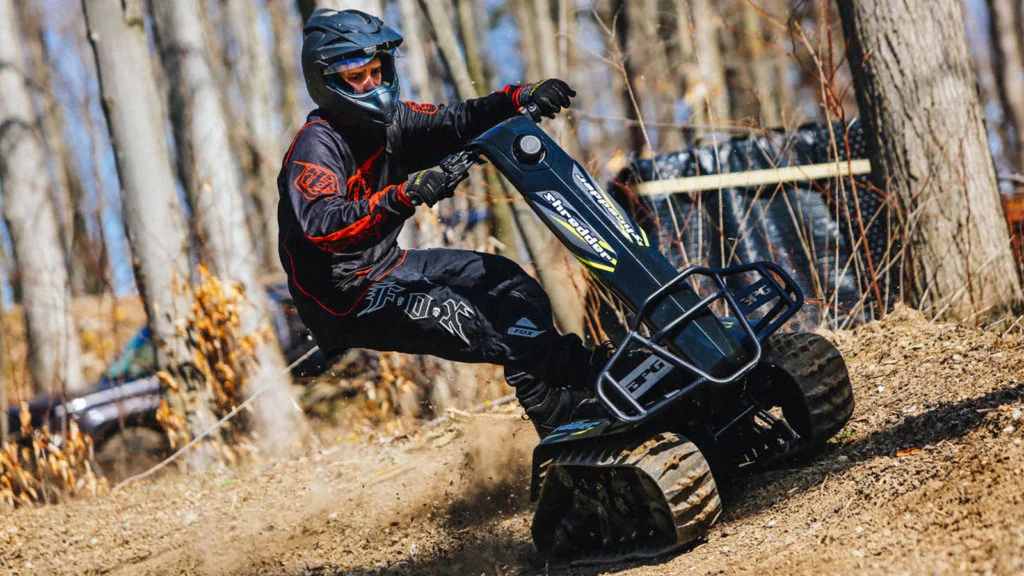
BPG DTV Shredder Trail - Specifications & Review
Article Complete Info
| Articleid | 559508 |
|---|---|
| Category | Prototype-concept model |
| Make | BPG |
| Model | DTV Shredder Trail |
| Year | 2017 |
Chassis, Suspension, Brakes & Wheels
| Frametype | Aluminum and Tubular Steel. Cast aluminum swing-arms. |
|---|---|
| Frontbrakes | Expanding brake (drum brake). Hydraulic |
| Frontsuspension | 6-point, independently articulating suspension system |
| Rearbrakes | Expanding brake (drum brake). Http://bpgwerks.com/products/ |
| Rearsuspension | 6-point, independently articulating suspension system |
| Seat | No seat |
| Wheels | Belts, no wheels |
Engine & Transmission
| Clutch | CVT |
|---|---|
| Coolingsystem | Air |
| Displacement | 196.00 ccm (11.96 cubic inches) |
| Enginedetails | Single cylinder, four-stroke |
| Fuelsystem | Carburettor |
| Gearbox | Automatic |
| Power | 14.00 HP (10.2 kW)) @ 4500 RPM |
| Topspeed | 40.0 km/h (24.9 mph) |
| Torque | 20.34 Nm (2.1 kgf-m or 15.0 ft.lbs) |
| Transmissiontypefinaldrive | Belt |
Other Specifications
| Coloroptions | Camo |
|---|---|
| Comments | All-terrain capability. Pivoting deck steering mechanism (skateboard style). Foldable. |
| Factorywarranty | One year |
| Starter | Electric |
Physical Measures & Capacities
| Dryweight | 127.0 kg (280.0 pounds) |
|---|---|
| Overallheight | 1,270 mm (50.0 inches) |
| Overalllength | 1,194 mm (47.0 inches) |
| Overallwidth | 686 mm (27.0 inches) |
| Powerweightratio | 0.1102 HP/kg |
| Weightincloilgasetc | 145.0 kg (319.7 pounds) |
About BPG
Country of Origin:
Canada
Founder:
Ben Gulak
Best Known For:
UNO transforming self-balancing concept; early personal-mobility experiments
Company History
BPG (most publicly associated with inventor Ben Gulak) occupied a fascinating niche in the late-2000s/early-2010s push to rethink personal mobility. The company’s best-known project, the UNO, explored a transformer-like vehicle that operated as a self-balancing two-wheeler at low speeds and reconfigured into a conventional wheelbase for higher-speed stability. The aim was to fuse the approachability of a Segway-style device with the practicality of a small scooter, all wrapped in a futuristic design that captured imaginations beyond motorcycling’s usual audience. From an engineering perspective, BPG wrestled with sensor fusion, control algorithms, and packaging challenges inherent in placing batteries, motors, and folding wheel assemblies into a compact, road-worthy object. Prototypes generated enormous media interest and prompted questions about regulation: Which category would such a vehicle fall into? What licenses and safety standards would apply? While BPG’s products remained limited and the company eventually pivoted, the work seeded ideas that later surfaced in other micromobility efforts—modular drivetrains, dynamic geometry, and the importance of user trust in balance-assist systems. Historically, BPG is less a manufacturer in the traditional sense and more a “what-if” laboratory that helped broaden the conversation about urban transport. It showed that curiosity and showmanship can rally attention around engineering, and that the boundary between motorcycle, scooter, and device is porous. For students and tinkerers who followed the UNO’s evolution, BPG served as an on-ramp to robotics, EV systems, and the entrepreneurial grit needed to move a vehicle from sketch to street.