
2013
Brammo Empulse RR - Specifications & Review
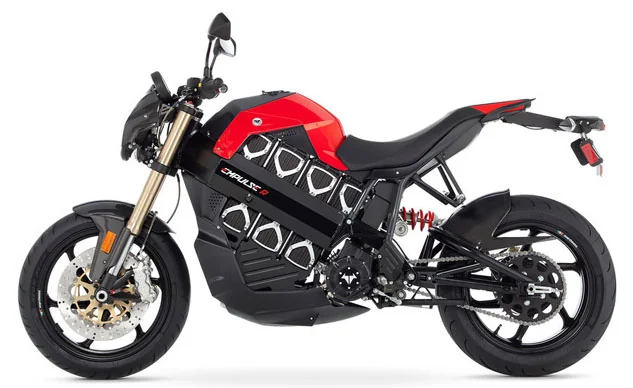
Article Complete Info
| Articleid | 111993 |
|---|---|
| Category | Sport |
| Make | Brammo |
| Model | Empulse RR |
| Year | 2013 |
Chassis, Suspension, Brakes & Wheels
| Frametype | Extruded and welded aluminum frame |
|---|---|
| Frontbrakes | Double disc. Nissin 4 piston, fixed caliper |
| Frontsuspension | 43mm inverted front fork |
| Fronttyre | 120/70-17 |
| Rearbrakes | Single disc. Brembo Single piston, floating caliper |
| Rearsuspension | Box-section style swingarm. Works Performance shocks. |
| Reartyre | 250/55-17 |
| Wheels | BST carbon wheels |
Engine & Transmission
| Clutch | Multi-plate, hydraulic activated wet clutch |
|---|---|
| Coolingsystem | Liquid |
| Driveline | Direct Chain Drive (14/48) 520 O-ring chain |
| Emissiondetails | No direct emission |
| Enginedetails | Electric |
| Enginetype | Parker GVM IPM Motor |
| Gearbox | 6-speed |
| Power | 53.64 HP (39.2 kW)) @ 4500 RPM |
| Topspeed | 169.0 km/h (105.0 mph) |
| Transmissiontypefinaldrive | Chain |
Other Specifications
| Comments | Lithium-Ion Battery. |
|---|---|
| Factorywarranty | 12 Months Limited Warranty |
| Instruments | MoTec dash |
| Starter | Electric |
Physical Measures & Capacities
| Dryweight | 212.0 kg (467.4 pounds) |
|---|---|
| Overallheight | 1,067 mm (42.0 inches) |
| Overalllength | 2,057 mm (81.0 inches) |
| Overallwidth | 780 mm (30.7 inches) |
| Powerweightratio | 0.2530 HP/kg |
| Seatheight | 810 mm (31.9 inches) If adjustable, lowest setting. |
About Brammo
Country of Origin:
United States
Founder:
Craig Bramscher
Best Known For:
Enertia and Empulse electric motorcycles; early TTXGP/AMA e-racing efforts
Company History
Brammo was among the first modern companies to put credible, road-legal electric motorcycles into the hands of everyday riders. Based in Oregon, it launched the Enertia as a city-range commuter with approachable ergonomics and clean, consumer-electronics styling. The Empulse followed with a liquid-cooled motor, higher voltage, and, crucially, a six-speed gearbox—an attempt to blend EV torque with the familiar engagement of shifting. Brammo didn’t just ship bikes; it raced them, using competition to harden thermal strategies, power delivery, and durability under sustained load. Early adopters learned that battery management and software updates mattered as much as sprocket choices, a cultural shift that helped define today’s e-moto ownership experience. The company faced the usual first-mover headwinds: capital intensity, dealer education, and the chicken-and-egg problem of charging infrastructure. Strategic partnerships and eventual acquisition of the motorcycle business by Polaris preserved much of the engineering know-how, which influenced later electric efforts across powersports. Historically, Brammo proved that electric motorcycles could be aspirational and fun, not just eco-appliances. Its designs emphasized balance and feedback, demonstrating that careful chassis tuning can make even a heavy battery pack dance. Owners still praise the Empulse’s mid-corner feel and the way its gearbox helps keep the motor in a sweet spot, a bridge between analog habits and digital drivetrains. In the broader narrative, Brammo’s legacy is the normalization of e-motos as legitimate choices for commuters and enthusiasts, paving the way for today’s expanding electric segment.