
2010
Buell XB12Scg Lightning - Specifications & Review
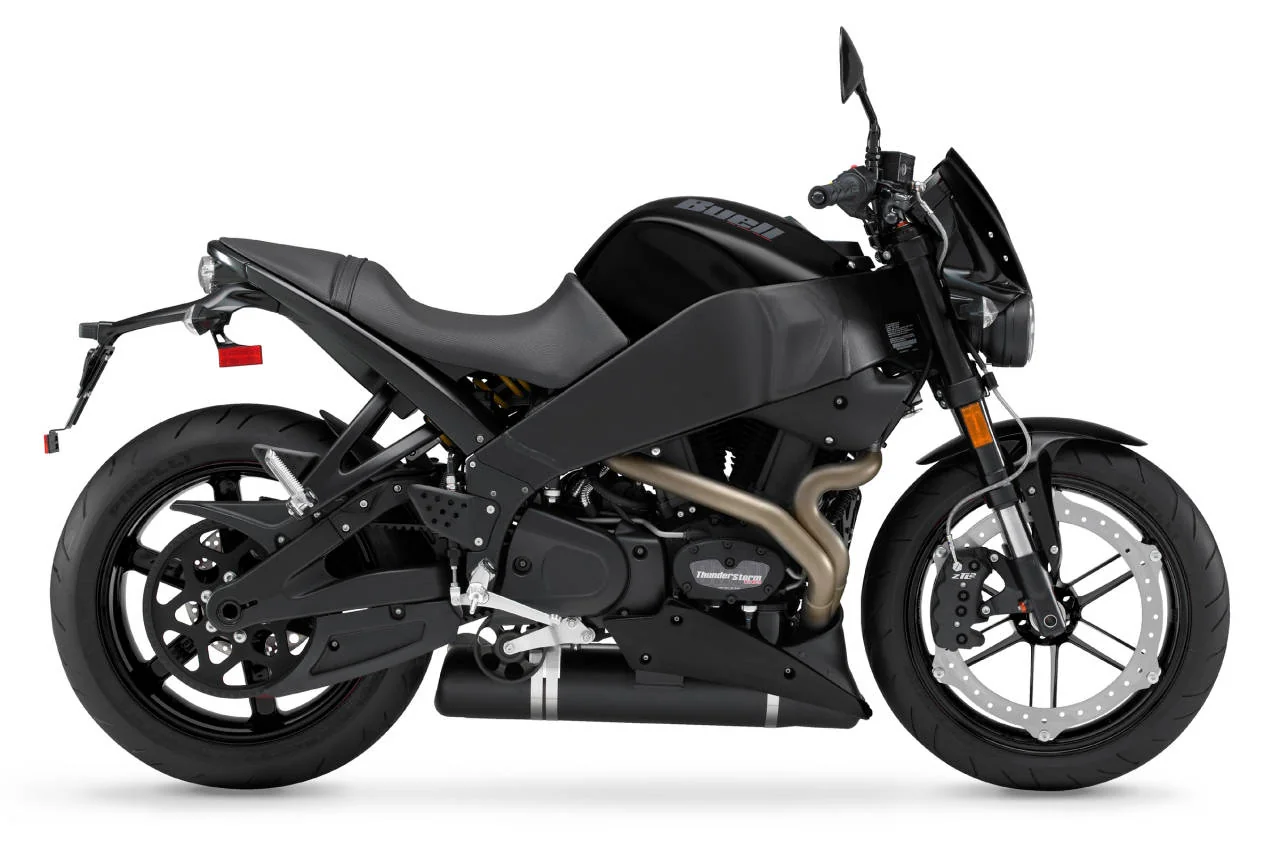
Article Complete Info
| Articleid | 906073 |
|---|---|
| Category | Naked bike |
| Make | Buell |
| Model | XB12Scg Lightning |
| Price | US$ 10299. Prices depend on country, taxes, accessories, etc. |
| Year | 2010 |
Chassis, Suspension, Brakes & Wheels
| Frametype | Black aluminium frame with Uniplanar™ powertrain vibration isolation system, fuel in frame |
|---|---|
| Frontbrakes | Single disc. ZTL2-type brake, 8-piston, 4 pads, fixed caliper, 375 mm single-sided, inside out, stainless steel, floating rotor |
| Frontbrakesdiameter | 375 mm (14.8 inches) |
| Frontsuspension | 41 mm Showa inverted forks with adjustable compression damping, rebound damping and spring preload |
| Fronttyre | 120/70-ZR17 |
| Frontwheeltravel | 79 mm (3.1 inches) |
| Rake | 21.0° |
| Rearbrakes | Single disc. Two-piston, direct mount caliper; stainless steel, fixed rotor |
| Rearbrakesdiameter | 240 mm (9.4 inches) |
| Rearsuspension | Showa coil-over monoshock with remote, under-seat reservoir and adjustable compression damping, rebound damping and spring preload |
| Reartyre | 180/55-ZR17 |
| Rearwheeltravel | 90 mm (3.6 inches) |
| Trail | 83 mm (3.3 inches) |
Engine & Transmission
| Borexstroke | 88.9 x 96.8 mm (3.5 x 3.8 inches) |
|---|---|
| Clutch | Wet, multi-plate, compensated |
| Coolingsystem | Oil & air |
| Displacement | 1202.88 ccm (73.40 cubic inches) |
| Enginedetails | V2, four-stroke |
| Exhaustsystem | Tuned, tri-pass resonance chamber with InterActive valve and mass-centralised mounting |
| Fuelsystem | Injection. 49 mm down draft DDFI II injection |
| Gearbox | 5-speed |
| Power | 103.00 HP (75.2 kW)) @ 6800 RPM |
| Torque | 113.90 Nm (11.6 kgf-m or 84.0 ft.lbs) @ 5500 RPM |
| Transmissiontypefinaldrive | Belt |
| Valvespercylinder | 2 |
Other Specifications
| Coloroptions | Villain Black, Kick Ash Translucid and Cherry Bomb Red Translucid |
|---|
Physical Measures & Capacities
| Dryweight | 179.2 kg (395.0 pounds) |
|---|---|
| Fuelcapacity | 14.45 litres (3.82 gallons) |
| Groundclearance | 90 mm (3.5 inches) |
| Oilcapacity | 2.40 litres (0.16 quarts) |
| Overalllength | 1,923 mm (75.7 inches) |
| Overallwidth | 754 mm (29.7 inches) |
| Powerweightratio | 0.5749 HP/kg |
| Reservefuelcapacity | 2.83 litres (0.75 gallons) |
| Seatheight | 759 mm (29.9 inches) If adjustable, lowest setting. |
About Buell
Country of Origin:
United States
Founder:
Erik Buell
Best Known For:
Mass centralization, fuel-in-frame, rim-mounted front brake; XB and 1125/1190 platforms
Company History
Buell Motorcycles, founded by engineer and former racer Erik Buell, reimagined sportbike design around mass centralization and chassis stiffness. Early Buells used Harley-Davidson V-twins in compact frames, evolving into the XB series with fuel stored inside the frame spars and a perimeter (rim-mounted) front brake that reduced unsprung weight. The result was agile steering, fierce mid-corner feedback, and a uniquely American take on the sportbike: torque-rich engines married to short wheelbases and steep geometry. Later, liquid-cooled Rotax-powered 1125 models pushed performance further. Buell’s partnership with Harley-Davidson provided factory resources and dealer reach, but strategic tensions and the 2008–09 downturn led to the brand’s closure under H-D ownership. Erik Buell returned with Erik Buell Racing (EBR), developing 1190cc superbikes that proved competitive yet financially difficult in a niche market. The Buell name has since resurfaced under new stewardship, underscoring how resilient the idea remains. Historically, Buell matters because it asked different questions: What if the frame carried fuel? What if the front rotor’s diameter increased while caliper mass shrank? What if rideability on real roads mattered as much as peak dyno numbers? For riders, a Buell offers character—snappy turn-in, stout midrange, and the feeling that the chassis is a living partner. Love or quibble with the quirks, the brand expanded sportbike vocabulary, leaving an imprint on how engineers and enthusiasts think about where weight lives and how a motorcycle should communicate at the limit.