
1988
Cagiva 125 C 9 Freccia - Specifications & Review
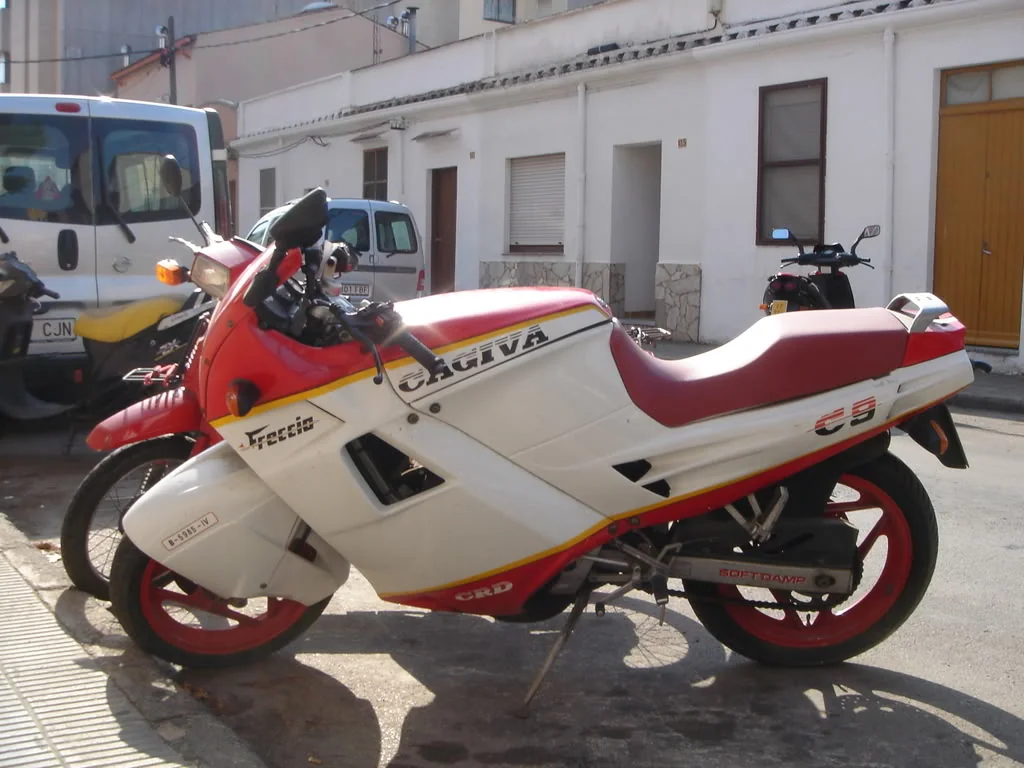
Article Complete Info
| Articleid | 302399 |
|---|---|
| Category | Sport |
| Make | Cagiva |
| Model | 125 C 9 Freccia |
| Year | 1988 |
Chassis, Suspension, Brakes & Wheels
| Frontbrakes | Single disc |
|---|---|
| Fronttyre | 100/80-16 |
| Rearbrakes | Single disc |
| Reartyre | 120/80-17 |
Engine & Transmission
| Borexstroke | 56.0 x 50.6 mm (2.2 x 2.0 inches) |
|---|---|
| Compression | 13.0:1 |
| Coolingsystem | Liquid |
| Displacement | 125.00 ccm (7.63 cubic inches) |
| Enginedetails | Single cylinder, two-stroke |
| Gearbox | 6-speed |
| Power | 24.00 HP (17.5 kW)) @ 10500 RPM |
| Topspeed | 155.0 km/h (96.3 mph) |
| Transmissiontypefinaldrive | Chain |
Physical Measures & Capacities
| Fuelcapacity | 16.00 litres (4.23 gallons) |
|---|---|
| Weightincloilgasetc | 138.0 kg (304.2 pounds) |
About Cagiva
Country of Origin:
Italy
Founder:
Claudio & Gianfranco Castiglioni
Best Known For:
Acquiring Ducati, Husqvarna, MV Agusta; Dakar wins and racy middleweights
Company History
Cagiva (CAstiglioni GIovanni VArese) began in the late 1970s when the Castiglioni brothers purchased an ailing factory in Varese and set out to build Italian motorcycles that mixed passion with industrial discipline. Through the 1980s and 1990s, Cagiva became a hub around which much of modern Italian motorcycling revolved, acquiring or stewarding storied names including Ducati, Husqvarna, and later MV Agusta. On track and in the desert, Cagiva’s ambitions were equally bold: its red Elefant rally bikes, animated by Ducati V-twins, famously conquered the Paris–Dakar, while two-stroke GP machines carried the brand’s crest in Grand Prix. Road models such as the Mito 125 taught generations of European riders that small displacement could still look and feel exotic, and 600–900 cc street bikes brought accessible Italian character to the middleweight class. Cagiva’s playbook blended design verve with clever platform sharing—an approach that kept costs in check while maintaining personality across model lines. Economic turbulence eventually forced divestitures and reorganization, with the Castiglionis refocusing on MV Agusta. Yet Cagiva’s imprint is everywhere: in the careers it launched, the factories it modernized, and the idea that a relatively small company could steer the global conversation through daring product and motorsport credibility. In the cultural memory of riders, Cagiva stands for audacity wrapped in red paint—a reminder that Italy’s motorcycle renaissance was engineered as much in Varese as in Bologna.