
2010
Can-Am DS 90 X - Specifications & Review
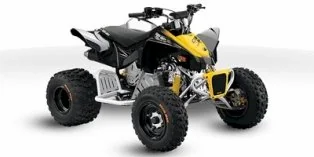
Article Complete Info
| Articleid | 904706 |
|---|---|
| Category | ATV |
| Make | Can-Am |
| Model | DS 90 X |
| Price | US$ 3399. Prices depend on country, taxes, accessories, etc. |
| Year | 2010 |
Chassis, Suspension, Brakes & Wheels
| Frametype | DS90 |
|---|---|
| Frontbrakes | Double disc |
| Frontsuspension | Double A-arm front suspension with 43-inch (109 cm) overall width. Front HPG piggyback shocks with 7 inches (18 cm) of travel. |
| Fronttyre | 19/7-8 |
| Rearbrakes | Single disc |
| Rearsuspension | Rear HPG piggyback shock with 9 inches (23 cm) of travel. |
| Reartyre | 18/10-8 |
Engine & Transmission
| Borexstroke | 49.5 x 48.0 mm (1.9 x 1.9 inches) |
|---|---|
| Coolingsystem | Air |
| Displacement | 89.50 ccm (5.46 cubic inches) |
| Enginedetails | Single cylinder, four-stroke |
| Fuelsystem | Carburettor. Keihin |
| Gearbox | Automatic |
| Transmissiontypefinaldrive | Chain |
Other Specifications
| Coloroptions | Yellow, Black |
|---|---|
| Comments | Automatic CVT, forward, neutral and reverse. |
| Starter | Electric & kick |
Physical Measures & Capacities
| Dryweight | 111.0 kg (244.7 pounds) |
|---|---|
| Fuelcapacity | 2.70 litres (0.71 gallons) |
| Groundclearance | 211 mm (8.3 inches) |
| Overallheight | 935 mm (36.8 inches) |
| Overalllength | 1,520 mm (59.8 inches) |
| Overallwidth | 905 mm (35.6 inches) |
| Seatheight | 685 mm (27.0 inches) If adjustable, lowest setting. |
About Can-Am
Country of Origin:
Canada
Founder:
Bombardier (BRP); legacy of Joseph-Armand Bombardier
Best Known For:
1970s MX/enduro race bikes; modern Spyder/Ryker three-wheelers and ATVs/UTVs
Company History
Can-Am began in the early 1970s as the motorcycle arm of Bombardier, leveraging Canadian engineering to create fiercely competitive two-stroke motocross and enduro machines. Tuned with European expertise and raced hard in North America and overseas, those early Can-Ams collected championships and cult status, proving that a snowmobile maker could out-hustle traditional bike brands in the dirt. As corporate priorities shifted, motorcycle production waned, but the Can-Am name later returned under BRP with a new mission: redefine powersports with three-wheeled roadsters. The Spyder and Ryker platforms offered stability, ABS/traction safety nets, and car-like ease that brought non-motorcyclists into open-air motoring. Parallel growth in ATVs and side-by-sides put Can-Am back into the off-road conversation at scale, competing directly with American and Japanese rivals. The throughline is confidence and accessibility—machines that extend the season, the terrain, or the rider base. Historically, Can-Am’s arc demonstrates corporate agility: pivot from two-stroke race weapons to sophisticated, electronically managed trikes without losing the brand’s appetite for fun. In the 1970s it asked dirt riders to imagine a Canadian upstart on the podium; today it invites highway travelers and trail workers to experience wind and utility with three contact patches. The brand’s enduring contribution is expanding who counts as a ‘rider,’ using engineering to lower barriers rather than raise them.