
2011
CPI Oliver Sport - Specifications & Review
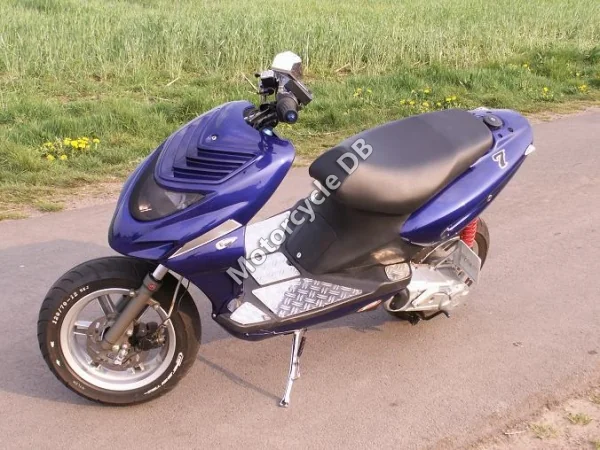
Article Complete Info
| Articleid | 507506 |
|---|---|
| Category | Scooter |
| Make | CPI |
| Model | Oliver Sport |
| Year | 2011 |
Chassis, Suspension, Brakes & Wheels
| Frontbrakes | Single disc |
|---|---|
| Frontbrakesdiameter | 190 mm (7.5 inches) |
| Frontsuspension | Hydraulic telescopic fork |
| Fronttyre | 120/70-12 |
| Rearbrakes | Expanding brake (drum brake) |
| Rearbrakesdiameter | 110 mm (4.3 inches) |
| Rearsuspension | Hydraulic suspension, adjustable |
| Reartyre | 130/70-12 |
Engine & Transmission
| Coolingsystem | Air |
|---|---|
| Displacement | 49.20 ccm (3.00 cubic inches) |
| Driveline | Automatic CVT |
| Enginedetails | Single cylinder, two-stroke |
| Exhaustsystem | INOX |
| Fuelconsumption | 2.20 litres/100 km (45.5 km/l or 106.92 mpg) |
| Fuelsystem | Carburettor |
| Gearbox | Automatic |
| Greenhousegases | 51.0 CO2 g/km. (CO2 - Carbon dioxide emission) |
| Ignition | C.D.I |
| Power | 4.16 HP (3.0 kW)) @ 7500 RPM |
| Torque | 4.40 Nm (0.4 kgf-m or 3.2 ft.lbs) @ 500 RPM |
| Transmissiontypefinaldrive | Belt |
Other Specifications
| Coloroptions | Blue/yellow, blue/orange |
|---|---|
| Comments | Chinese brand. |
| Starter | Electric & kick |
Physical Measures & Capacities
| Dryweight | 85.0 kg (187.4 pounds) |
|---|---|
| Fuelcapacity | 5.20 litres (1.37 gallons) |
| Oilcapacity | 1.40 litres (0.09 quarts) |
| Overallheight | 1,139 mm (44.8 inches) |
| Overalllength | 1,839 mm (72.4 inches) |
| Overallwidth | 664 mm (26.1 inches) |
| Powerweightratio | 0.0489 HP/kg |
About CPI
Country of Origin:
Taiwan
Founder:
CPI Motor Co. engineering team
Best Known For:
Export scooters and small motorcycles balancing price and reliability
Company History
CPI Motor Co. emerged from Taiwan’s maturing powersports sector as an exporter of practical scooters and small motorcycles that hit the sweet spot for students, commuters, and fleet operators. The company rode the island’s strengths—plastics, precision casting, and a supplier network shared with major OEMs—to deliver products that felt a step up from bargain-basement offerings while keeping prices approachable. Typical CPI scooters use tuned-for-longevity air-cooled singles and CVTs, with braking and lighting packages compliant across diverse markets. Over the years, CPI tightened quality control, improved electrical robustness, and adopted EFI where regulations demanded, incrementally closing the gap with Japanese and European rivals. Distribution partners mattered: CPI worked through importers who invested in parts pipelines and documentation, understanding that aftersales confidence turns one purchase into word of mouth. While CPI never chased race pedigree, it earned a reputation for honest value—machines that started on cold mornings, shrugged off potholes, and were inexpensive to keep on the road. Historically, CPI stands as a case study in Taiwan’s move from contract builder to brand: the incrementalist path where small improvements accumulate into trust. In the lived reality of cities, a CPI’s story is measured in errands run and paychecks earned, proving that competence at scale can be as transformative as any headline-grabbing superbike.