
2023
Curtiss 1 Electric - Specifications & Review
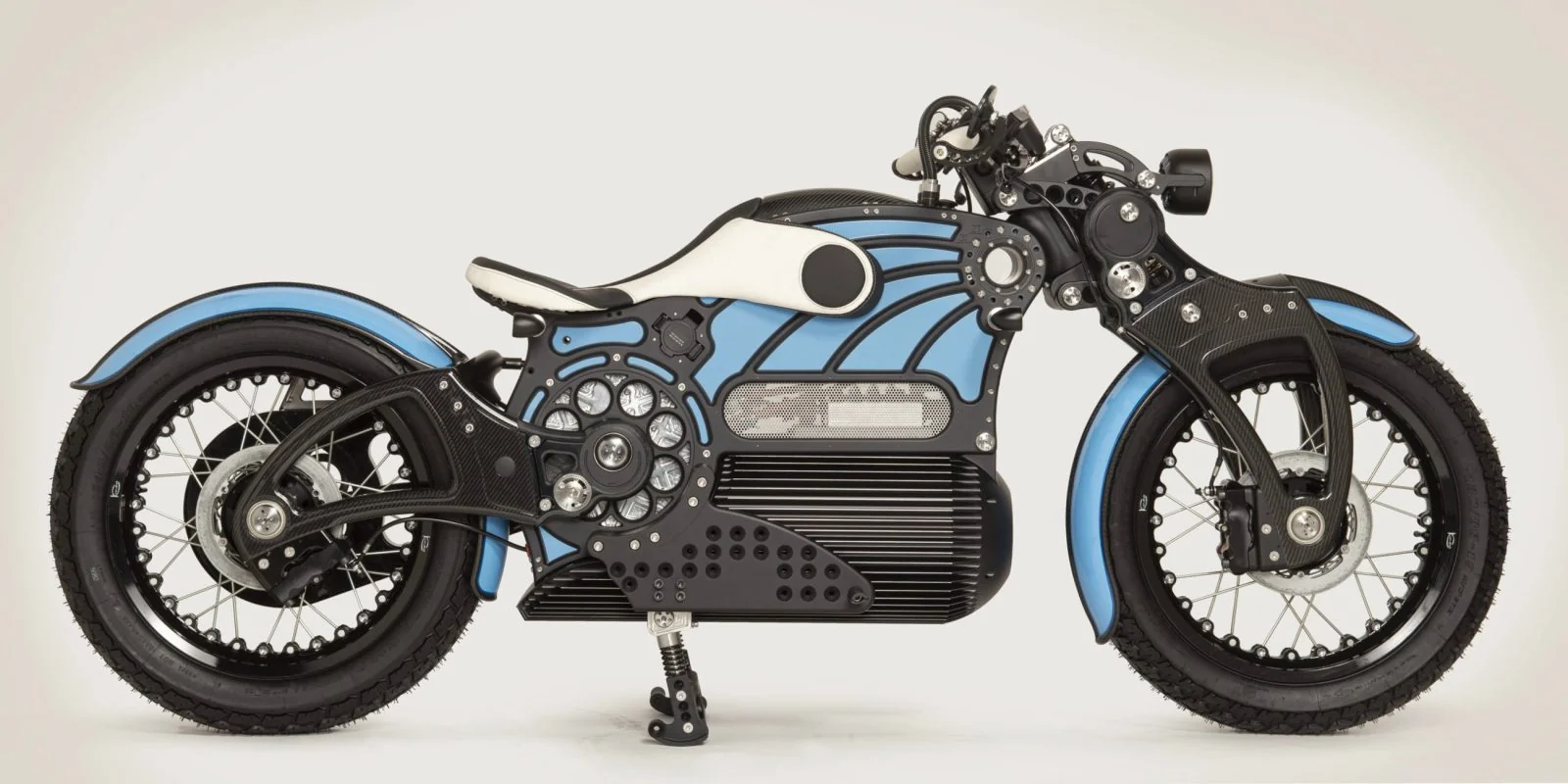
Article Complete Info
| Articleid | 976889 |
|---|---|
| Category | Prototype-concept model |
| Make | Curtiss |
| Model | 1 Electric |
| Price | US$ 120000. MSRP depends on country, taxes, accessories, etc. |
| Year | 2023 |
Chassis, Suspension, Brakes & Wheels
| Frontbrakes | Double disc |
|---|---|
| Frontsuspension | Custom shocks by RaceTec |
| Fronttyre | 130/80-19 |
| Rake | 27.0° |
| Rearbrakes | Single disc |
| Rearsuspension | Custom shocks by RaceTec |
| Reartyre | 140/80-19 |
| Seat | Solo seat |
| Wheels | Cast alloy, 5-spoke black. Dunlop tires. |
Engine & Transmission
| Coolingsystem | Liquid |
|---|---|
| Enginedetails | Axial flux YASA P400 motor |
| Enginetype | Electric |
| Power | 110.0 HP (80.3 kW)) |
| Torque | 200.0 Nm (20.4 kgf-m or 147.5 ft.lbs) |
| Transmissiontypefinaldrive | Belt (final drive) |
Other Specifications
| Coloroptions | Black, custom colored panels |
|---|---|
| Comments | Fully-adjustable wheelbase, rider ergonomics, rake and trail. Handcrafted from machined-billet aluminum, titanium and carbon fiber.. 8.8 kWh liquid cooled battery. 2 hours 40 min charging. Range 120 miles city, 70 miles highway. Regenerative braking. Limited edition, only 120 bikes will be made. |
| Starter | Electric |
Physical Measures & Capacities
| Alternateseatheight | 737 mm (29.0 inches) If adjustable, highest setting. |
|---|---|
| Groundclearance | 203 mm (8.0 inches) |
| Overalllength | 2286 mm (90.0 inches) |
| Overallwidth | 686 mm (27.0 inches) |
| Seatheight | 686 mm (27.0 inches) If adjustable, lowest setting. |
| Weightincloilgasetc | 192.8 kg (425.0 pounds) |
About Curtiss
Country of Origin:
United States
Founder:
H. Matthew Chambers (brand pivot of Confederate); inspired by Glenn H. Curtiss
Best Known For:
Design-forward electric motorcycles (e.g., Hades/One concepts) and luxury EV craftsmanship
Company History
Curtiss Motorcycle Company represents the electric-era reframing of the radical design philosophy once known as Confederate. Retiring the old name, the team embraced a cleaner, futurist identity while paying homage to aviation pioneer Glenn Curtiss, whose 1907 V-8 motorcycle land-speed run still echoes through motorcycling lore. The modern Curtiss projects center on electric powertrains presented as sculpture: battery packs and motor housings arranged like architectural elements inside minimal frames, with suspension and controls designed to keep visual clutter low. The brand’s goal is not mass adoption but craft—limited-series machines that treat electrons as an opportunity to rethink proportion, structure, and the rider’s interface. Without an engine’s heat and vibration constraints, designers experiment with new packaging, seeking balance and poise rather than filling voids once occupied by cylinders. Commercialization is challenging at such low volumes, and concepts evolve as suppliers and regulations shift. Yet the cultural value of Curtiss lies in its insistence that premium motorcycling can be electric without becoming appliance-like. Historically, the company extends a century-old American narrative: from Glenn Curtiss’s speed-as-spectacle to 21st-century design-as-spectacle, always asking what a motorcycle should look and feel like when freed from convention. For enthusiasts, Curtiss functions as a laboratory where the language of luxury bikes—materials, stance, handwork—learns to speak in volts and new geometries.