
1957
DKW RT 125 2H - Specifications & Review
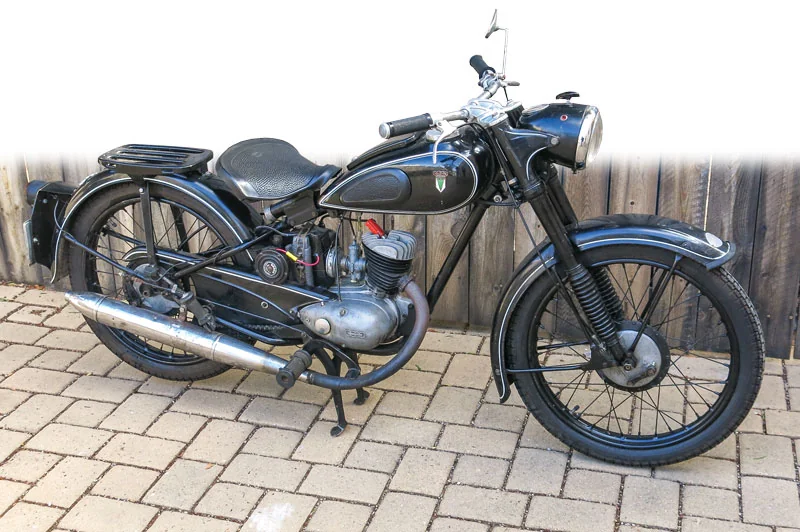
Article Complete Info
| Articleid | 558680 |
|---|---|
| Category | Sport |
| Make | DKW |
| Model | RT 125 2H |
| Year | 1957 |
Chassis, Suspension, Brakes & Wheels
| Frametype | Single cradle |
|---|---|
| Frontbrakes | Expanding brake (drum brake) |
| Frontsuspension | Telescopic fork |
| Fronttyre | 2.50-19 |
| Rearbrakes | Expanding brake (drum brake) |
| Rearsuspension | None |
| Reartyre | 2.50-19 |
Engine & Transmission
| Borexstroke | 52.0 x 58.0 mm (2.0 x 2.3 inches) |
|---|---|
| Clutch | Wet multiplate |
| Compression | 6.5:1 |
| Coolingsystem | Air |
| Displacement | 123.00 ccm (7.51 cubic inches) |
| Enginedetails | Single cylinder, two-stroke |
| Fuelsystem | Carburettor |
| Gearbox | 3-speed |
| Ignition | Magneto |
| Power | 5.70 HP (4.2 kW)) @ 5000 RPM |
| Topspeed | 84.0 km/h (52.2 mph) |
| Transmissiontypefinaldrive | Chain |
Other Specifications
| Starter | Kick |
|---|
Physical Measures & Capacities
| Overallheight | 660 mm (26.0 inches) |
|---|---|
| Overalllength | 1,959 mm (77.1 inches) |
| Overallwidth | 660 mm (26.0 inches) |
About DKW
Country of Origin:
Germany
Founder:
Jörgen Skafte Rasmussen
Best Known For:
Prolific pre/post-war two-strokes; RT 125 that inspired global clones
Company History
DKW—Dampf-Kraft-Wagen—was once the world’s largest motorcycle maker and a pillar of Auto Union (the ancestor of Audi). Founded by J. S. Rasmussen, the brand specialized in light, affordable two-strokes that mobilized interwar and postwar Europe. Its most influential design, the RT 125, became a template copied or licensed globally after WWII: BSA Bantam in Britain, Harley-Davidson Hummer in the U.S., and M1A in the USSR. Simple, rugged, and inexpensive to run, the RT 125 democratized riding and seeded mechanical know-how in garages everywhere. DKW also pushed racing two-strokes, experimenting with supercharging and advanced porting before war and politics reshaped the industry. After the war, East and West German successors carried parts of the lineage, while Auto Union focused increasingly on automobiles. Historically, DKW’s imprint is outsized: it proved that intelligent simplicity at scale can change how nations move, and that a well-drawn 125 can be worth more to society than the fastest exotic. Enthusiasts treasure surviving models for their mechanical transparency—piston-port thrum, hand-shift charm—and for the way they connect to a century-old design conversation that still echoes in every modern small two-stroke.