
1960
Dürkopp MD 176 - Specifications & Review
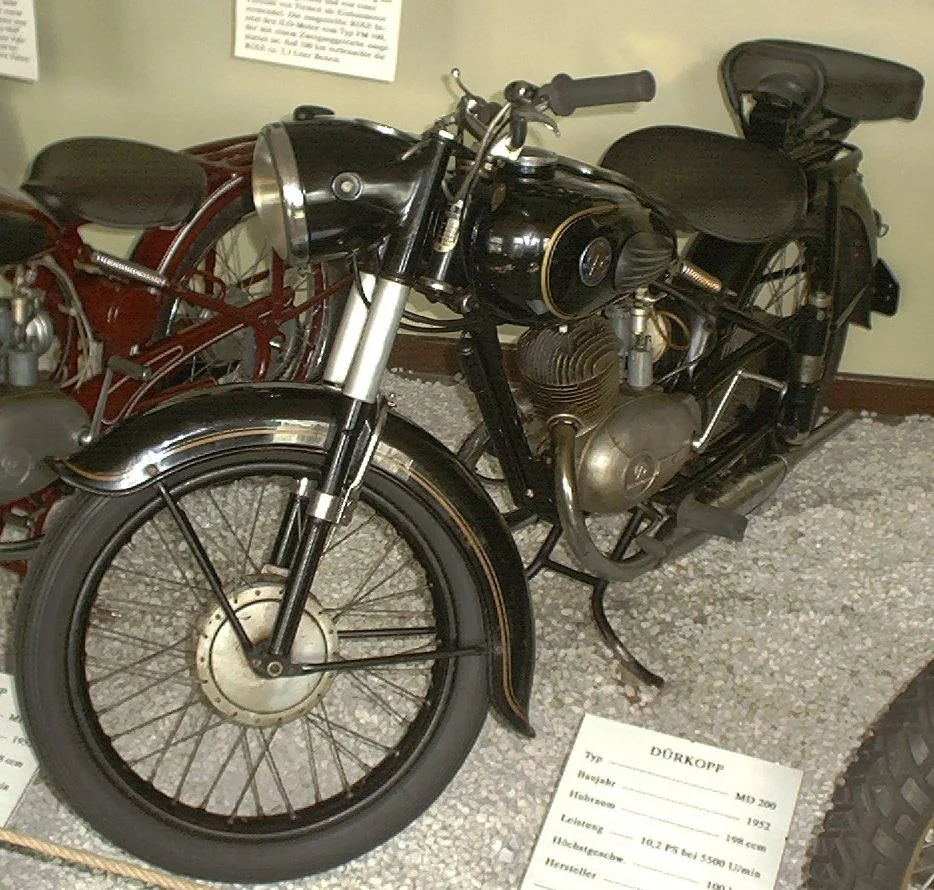
Article Complete Info
| Articleid | 391762 |
|---|---|
| Category | Sport |
| Make | Dürkopp |
| Model | MD 176 |
| Year | 1960 |
Chassis, Suspension, Brakes & Wheels
| Frametype | Single cradle |
|---|---|
| Frontbrakes | Expanding brake (drum brake) |
| Frontsuspension | Hydraulic telescopic |
| Fronttyre | 1.85-19 |
| Rearbrakes | Expanding brake (drum brake) |
| Rearsuspension | Two shock |
| Reartyre | 1.85-19 |
| Wheels | Spoked |
Engine & Transmission
| Borexstroke | 61.0 x 60.0 mm (2.4 x 2.4 inches) |
|---|---|
| Clutch | Wet multiplate |
| Compression | 7.0:1 |
| Coolingsystem | Air |
| Displacement | 173.00 ccm (10.56 cubic inches) |
| Enginedetails | Single cylinder, two-stroke |
| Fuelsystem | Carburettor |
| Ignition | Magneto |
| Power | 10.50 HP (7.7 kW)) @ 5600 RPM |
| Transmissiontypefinaldrive | Chain |
Physical Measures & Capacities
| Dryweight | 124.0 kg (273.4 pounds) |
|---|---|
| Overalllength | 2,030 mm (79.9 inches) |
| Powerweightratio | 0.0847 HP/kg |
About Dürkopp
Country of Origin:
Germany
Founder:
Nikolaus Dürkopp
Best Known For:
Early 20th-century German motorcycles from a sewing-machine/industrial giant
Company History
Dürkoppwerke, rooted in Bielefeld’s sewing-machine and bicycle industry, ventured into motorcycle production in the early 1900s, reflecting a broader European trend of diversified engineering firms applying their machining prowess to new mobility. Dürkopp’s motorcycles ranged from modest singles to more ambitious twins, with attention to fit, finish, and reliable ignition—virtues valued by a growing middle class that needed dependable transport. Pre-WWI models carried the company’s reputation for precision; interwar offerings kept pace with incremental improvements in carburation, braking, and lighting. As Germany’s economy and infrastructure shifted between wars and recovery, Dürkopp rationalized product lines and eventually retreated from motorcycles to focus on core industrial strengths: sewing machines, conveyors, and automation. Historically, Dürkopp’s motorcycle chapter underscores how the industry’s backbone was built by firms that could cast, grind, and assemble to high standards long before specialized OEMs dominated. Surviving machines are rare but admired by collectors who appreciate the clarity of early German design—purposeful, tidy, and mechanically honest—embodying a moment when the boundaries between household machinery and personal transport were delightfully permeable.