
2011
Exile Cycles Fat Bloke - Specifications & Review
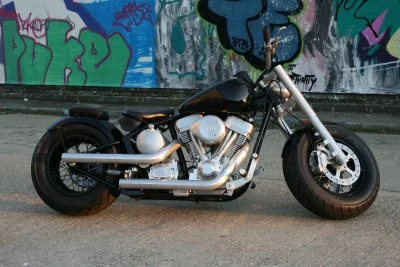
Article Complete Info
| Articleid | 218557 |
|---|---|
| Category | Custom-cruiser |
| Make | Exile Cycles |
| Model | Fat Bloke |
| Price | US$ 55000. Prices depend on country, taxes, accessories, etc. |
| Year | 2011 |
Chassis, Suspension, Brakes & Wheels
| Frametype | Softail frame, w swingarm, pivot axle and rock-guard, 35 degree |
|---|---|
| Frontbrakes | Single disc. Exile front brake caliper, 4-piston, SCOTCHBRITE |
| Frontbrakesdiameter | 292 mm (11.5 inches) |
| Frontsuspension | Showa FLST fork |
| Rearbrakes | Single disc. Exile brake rotor, 11.5´, stainless steel |
| Rearsuspension | Works Performance adjustable length Softail shocks, black |
| Wheels | Monster front wheel, 15´x5´, with 200 Metzeler tire, single-flange, SCOTCHBRITE hub and rim. Monster rear wheel, 15´x7´ with 230 tire, single flange, SCOTCHBRITE hub and rim |
Engine & Transmission
| Displacement | 1982.96 ccm (121.00 cubic inches) |
|---|---|
| Driveline | JIMS 6-speed transmission. Primo 3´ open belt kit with clutch. Nickel-plated O-ring chain. |
| Enginedetails | V2, four-stroke |
| Enginetype | Total Performance 121 cinch engine |
| Exhaustsystem | Exile 2.5´ Monster drag pipes with baffles and polished billet tip (raw steel) |
| Fuelsystem | Carburettor. S and S Super G carb |
| Ignition | Crane HI-4 single fire ignition system |
| Transmissiontypefinaldrive | Belt |
Other Specifications
| Coloroptions | Custom |
|---|---|
| Comments | Custom bike also available as a kit. |
| Electrical | Yuasa YTX20HL-BS battery |
| Light | SJP single headlight, 3.5´, H4 halogen |
| Starter | Electric |
About Exile Cycles
Country of Origin:
United States
Founder:
Russell Mitchell
Best Known For:
Minimalist, industrial custom V-twins with raw metal and purposeful stance
Company History
Exile Cycles carved a distinct lane in the custom scene by rejecting excess chrome and baroque paint in favor of stripped, industrial intent. British-born founder Russell Mitchell brought a designer’s eye to American big-twin customs: clean lines, machined aluminum, satin finishes, and hardware chosen for function as much as form. The bikes’ stance—low, muscular, and balanced—reads as ruthless clarity rather than ostentation. Television era exposure introduced Exile’s aesthetic to a broad audience, but the workshop’s reputation was built on rideability: proper trail numbers, brakes that bite, and ergonomics that let owners do miles, not just photo ops. Catalog parts—wheels, controls, bars—translated the look into a modular system riders could apply to their own builds, spreading the brand’s influence across garages worldwide. In a market that ebbs with fashion and disposable income, Exile’s less-is-more ethic aged well; raw metal and honest engineering feel timeless next to fad finishes. Historically, Exile helped reset expectations for American customs: purposeful can be beautiful; restraint can be luxurious. The shop showed that a coherent visual language, backed by competent geometry and reliable components, creates bikes that hold value in both use and memory. For many, an Exile is the antidote to overwork—a tough, elegant machine that whispers instead of shouts.