
2009
Fischer MRX SP - Specifications & Review
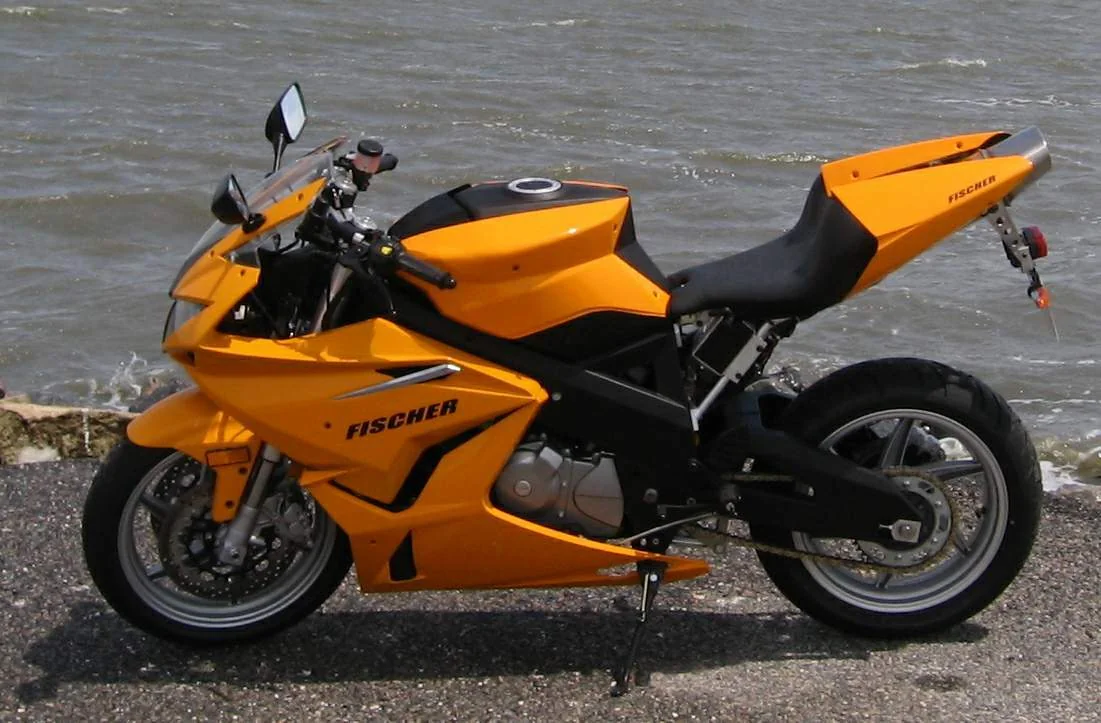
Article Complete Info
| Articleid | 213191 |
|---|---|
| Category | Sport |
| Make | Fischer |
| Model | MRX SP |
| Price | US$ 7999. Prices depend on country, taxes, accessories, etc. |
| Year | 2009 |
Chassis, Suspension, Brakes & Wheels
| Frametype | One-piece alloy frame |
|---|---|
| Frontbrakes | Double disc |
| Frontsuspension | 43mm inverted telescopic with compression and rebound adjustment |
| Fronttyre | 120/70-ZR17 |
| Rearbrakes | Single disc |
| Rearsuspension | Ohlins single shock with adjustable ride height, compression damping, and spring preload |
| Reartyre | 160/60-ZR17 |
| Trail | 98 mm (3.9 inches) |
Engine & Transmission
| Borexstroke | 81.6 x 62.0 mm (3.2 x 2.4 inches) |
|---|---|
| Coolingsystem | Liquid |
| Displacement | 647.00 ccm (39.48 cubic inches) |
| Enginedetails | V2, four-stroke |
| Exhaustsystem | Dual-chamber stainless |
| Fuelsystem | Carburettor. Dual Mikuni |
| Gearbox | 6-speed |
| Ignition | Computer-controlled digital with variable mapping |
| Power | 77.00 HP (56.2 kW)) @ 9400 RPM |
| Torque | 52.00 Nm (5.3 kgf-m or 38.4 ft.lbs) @ 7500 RPM |
| Valvespercylinder | 4 |
Other Specifications
| Coloroptions | Solar Fury, Rocket Red, StarWhite, Executive Ebony, Silver Carbon Stealth |
|---|---|
| Starter | Electric |
Physical Measures & Capacities
| Alternateseatheight | 800 mm (31.5 inches) If adjustable, highest setting. |
|---|---|
| Dryweight | 157.4 kg (347.0 pounds) |
| Fuelcapacity | 17.03 litres (4.50 gallons) |
| Powerweightratio | 0.4892 HP/kg |
| Seatheight | 749 mm (29.5 inches) If adjustable, lowest setting. |
About Fischer
Country of Origin:
United States
Founder:
Daniel Fischer
Best Known For:
MRX 650 sportbike—rare American middleweight with composite frame elements
Company History
The Fischer MRX 650 was a sincere attempt to give America a homegrown, affordable sportbike that prioritized handling over spec-sheet warfare. Designer and racer Daniel Fischer paired a proven 90-degree V-twin with a chassis using composite-assisted frame elements and quality suspension, aiming for approachable ergonomics and neutral steering. The goal: a bike that would flatter newer riders yet reward experts on tight backroads. Supply-chain fragility and the 2008 downturn constrained volumes, but the MRX earned respect from testers who found it cohesive and charmingly focused. In a market dominated by Japanese precision and European electronics, Fischer’s proposition—simplicity, feel, and domestic identity—was both refreshing and commercially difficult. Historically, the MRX stands as a reminder that the middleweight class thrives on balance, not bravado. It also illustrates the hurdles small OEMs face: emissions certification, dealer support, and capital to ride out economic squalls. Surviving MRXs are cult favorites, celebrated for their rarity and for embodying the idea that thoughtful engineering can make 650cc feel like plenty when geometry, seat-bar-peg triangle, and throttle mapping are nailed.