
2009
American Eagle Falcon MS Cruiser - Specifications & Review
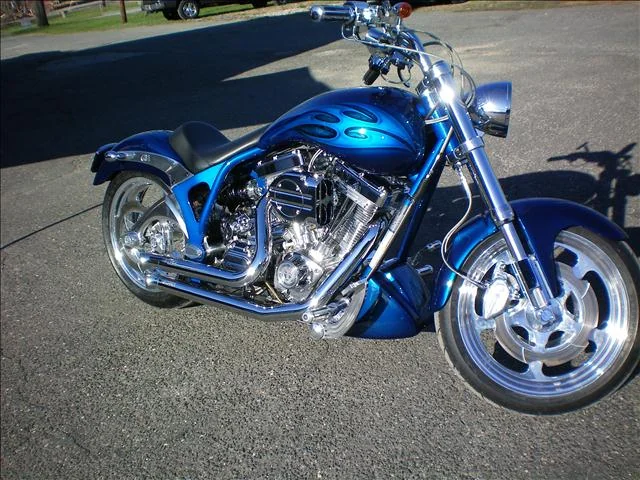
Article Complete Info
| Articleid | 101661 |
|---|---|
| Category | Custom-cruiser |
| Make | American Eagle |
| Model | Falcon MS Cruiser |
| Year | 2009 |
Chassis, Suspension, Brakes & Wheels
| Frametype | American Eagle Mono Shock Frame |
|---|---|
| Frontbrakes | Single disc. 4-piston cali |
| Frontbrakesdiameter | 292 mm (11.5 inches) |
| Frontsuspension | 54mm Inverted Forks |
| Fronttyre | 120/70-ZK17 |
| Rake | 30.0° |
| Rearbrakes | Single disc |
| Rearbrakesdiameter | 292 mm (11.5 inches) |
| Rearsuspension | Adjustable Mono-Shock |
| Reartyre | 180/55-ZR17 |
Engine & Transmission
| Displacement | 1638.81 ccm (100.00 cubic inches) |
|---|---|
| Enginedetails | V2, four-stroke |
| Fuelsystem | Carburettor |
| Gearbox | 5-speed |
| Ignition | Solid state ignition box with diagnostics |
| Transmissiontypefinaldrive | Belt |
Other Specifications
| Comments | Optional 2 up passenger seat. |
|---|---|
| Starter | Electric |
Physical Measures & Capacities
| Dryweight | 265.4 kg (585.0 pounds) |
|---|---|
| Seatheight | 610 mm (24.0 inches) If adjustable, lowest setting. |
About American Eagle
Country of Origin:
United States
Founder:
Jack McCormack & Michael Berliner (American Eagle Motorcycle Co., Los Angeles)
Best Known For:
Re-badged Laverda/Italjet models for the U.S. market in the late 1960s
Company History
American Eagle was a savvy import badge created by industry veterans Jack McCormack and Michael Berliner to bring stylish European machinery to U.S. buyers without the tangle of multiple small distributors. The company sourced from Laverda and Italjet among others, branding everything from lively small-bores to muscular twins as ‘American Eagle’ and backing them with coherent marketing and spares. The approach fit a moment when American riders were curious about European handling and style but wanted clear documentation and parts support. Short corporate life and shifting supplier relations limited volume, yet the brand helped Laverda find American garages and introduced many riders to the pleasures of revvy, precise Italian machines. Historically, American Eagle is a story about translation—adapting European engineering to American retail realities, bundling disparate models under one recognizable tank decal, and smoothing the ownership experience. Surviving bikes are snapshots of a cultural exchange: Venice orange meets California sunshine, with dealer tags that trace a brief, energetic chapter in U.S. motorcycling.