
1897
Hildebrand-Wolfmüller Motorrad - Specifications & Review
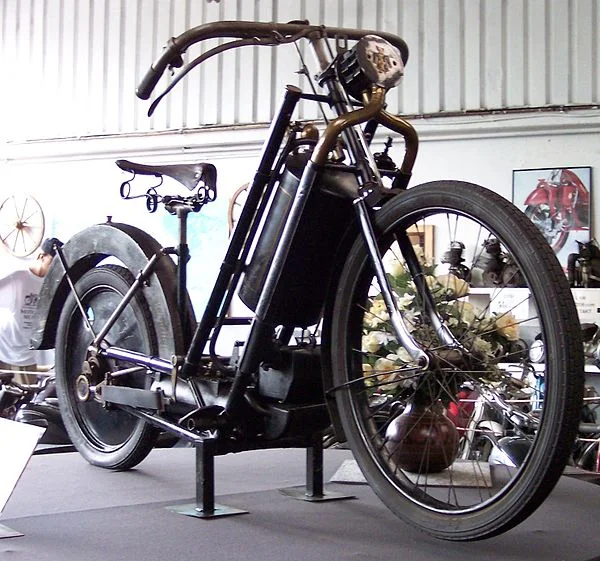
Article Complete Info
| Articleid | 415343 |
|---|---|
| Category | Allround |
| Make | Hildebrand-Wolfmüller |
| Model | Motorrad |
| Year | 1897 |
Chassis, Suspension, Brakes & Wheels
| Frametype | Tubular duplex |
|---|---|
| Frontsuspension | Front fork |
| Rearsuspension | None |
| Seat | Bicycle seat |
| Wheels | 26 in front wheel, 22 inch rear wheel. |
Engine & Transmission
| Borexstroke | 90.0 x 117.0 mm (3.5 x 4.6 inches) |
|---|---|
| Coolingsystem | Liquid |
| Displacement | 1489.00 ccm (90.86 cubic inches) |
| Driveline | Direct drive via connecting rods |
| Enginedetails | Twin, four-stroke |
| Enginetype | Flat engine |
| Fuelsystem | Carburettor |
| Gearbox | 1-speed |
| Ignition | Hot tube |
| Power | 2.50 HP (1.8 kW)) @ 240 RPM |
| Topspeed | 45.0 km/h (28.0 mph) |
| Transmissiontypefinaldrive | Shaft drive (cardan) |
Physical Measures & Capacities
| Dryweight | 50.0 kg (110.2 pounds) |
|---|---|
| Powerweightratio | 0.0500 HP/kg |
About Hildebrand-Wolfmüller
Country of Origin:
Germany
Founder:
Heinrich & Wilhelm Hildebrand with Alois Wolfmüller
Best Known For:
First series-production internal-combustion motorcycle (c. 1894–1897)
Company History
The Hildebrand & Wolfmüller is the point where the motorcycle becomes a product, not a prototype. Built in Munich in the 1890s, it used a water-cooled parallel twin mounted low in a step-through frame, driving the rear wheel directly via connecting rods in a system that predated modern clutches and gearboxes. There was no carburetor as we’d recognize it, no chain drive, and braking was minimal—yet the machine moved under its own combustion power with repeatable reliability. Advertising and licensed production abroad followed, establishing the template of an engineered, catalogued vehicle available to the public. Limitations were real: starting rituals were fussy, roads were primitive, and users learned quickly about heat and lubrication. But the existence of a production line—fixtures, jigs, spares—separated this machine from contemporaries that were essentially one-offs. Historically, Hildebrand-Wolfmüller anchors the origin story: a junction of bicycle craft and nascent engine science that let personal motor transport escape the lab. To see one today is to feel the audacity of engineers who believed explosions between two wheels could become civilized motion.