
2012
Mission R - Specifications & Review
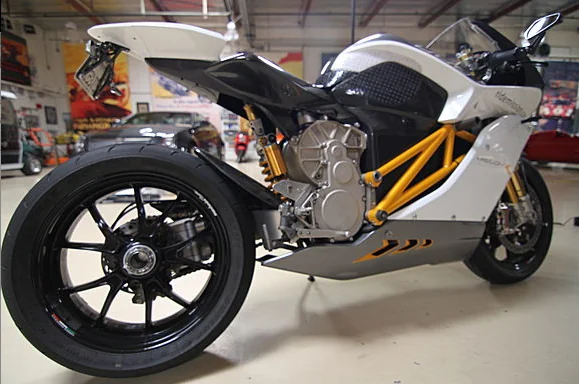
Article Complete Info
| Articleid | 191110 |
|---|---|
| Category | Sport |
| Make | Mission |
| Model | R |
| Year | 2012 |
Chassis, Suspension, Brakes & Wheels
| Frametype | RADD-designed Quad-Element Frame. Billet aluminum and chrome-moly |
|---|---|
| Frontbrakes | Double disc. Bremo, narrow-band racing stainless rotors |
| Frontbrakesdiameter | 310 mm (12.2 inches) |
| Frontsuspension | Öhlins FGR-000 TTX25 Gas Charged Fork |
| Fronttyre | 120/70-ZR17 |
| Rearbrakes | Single disc. Bremo, 2-piece billet 4-piston 30/34 mm differential bore radial-mount calipers |
| Rearbrakesdiameter | 245 mm (9.6 inches) |
| Rearsuspension | Single-sided billet aluminum swingarm with linear wheelbase/chain adjustment. Öhlins TTX36 Shock and linkage system. Adjustment for preload, ride height, high and low speed compression and rebound. |
| Reartyre | 190/60-ZR17 |
| Wheels | Black Marchesini forged magnesium 10-spoke. |
Engine & Transmission
| Coolingsystem | Liquid |
|---|---|
| Driveline | O-ring chain |
| Enginedetails | Electric |
| Enginetype | 3 phase AC induction motor |
| Gearbox | 1-speed |
| Power | 141.00 HP (102.9 kW)) |
| Topspeed | 257.5 km/h (160.0 mph) |
| Torque | 155.94 Nm (15.9 kgf-m or 115.0 ft.lbs) |
| Transmissiontypefinaldrive | Chain |
Other Specifications
| Coloroptions | White/gray/yellow |
|---|---|
| Comments | Battery Pack: High Energy Lithium-Ion of 14.4 kWh w/Integrated Thermal Management System. Regenerative braking. |
| Starter | Electric |
About Mission
Country of Origin:
United States
Founder:
Mission Motors / Mission Motorcycles (team including Forrest North; later leadership evolved)
Best Known For:
Mission R electric superbike prototypes and e-powertrain development
Company History
Mission sought to build world-class electric superbikes while selling e-drivetrain tech to other industries. The Mission R dazzled with track performance and design polish, showcasing high-density batteries, robust cooling, and sophisticated control software. Business realities—capital intensity, supplier risk, and the challenge of scaling a service network—ultimately limited production, but the engineering advances influenced EV thinking across the sector. Riders and journalists remember the immediacy: no shifting, deep regen, and corner exits that felt like elastic slingshots. Historically, Mission sits in the lineage of startups that, even without mass-market success, move the state of the art forward—raising expectations for feel, thermal stability, and software transparency in electric motorcycles.