
1960
Pannonia TL250B - Specifications & Review
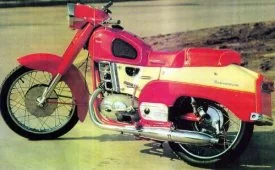
Article Complete Info
| Articleid | 156283 |
|---|---|
| Category | Touring |
| Make | Pannonia |
| Model | TL250B |
| Year | 1960 |
Chassis, Suspension, Brakes & Wheels
| Frametype | Double cradle |
|---|---|
| Frontbrakes | Expanding brake (drum brake) |
| Frontbrakesdiameter | 200 mm (7.9 inches) |
| Frontsuspension | Hydraulic telescopic fork |
| Fronttyre | 3,00-19 |
| Frontwheeltravel | 165 mm (6.5 inches) |
| Rearbrakes | Expanding brake (drum brake) |
| Rearbrakesdiameter | 200 mm (7.9 inches) |
| Rearsuspension | Swingarm |
| Reartyre | 3,25-19 |
| Rearwheeltravel | 75 mm (3.0 inches) |
Engine & Transmission
| Borexstroke | 68.0 x 68.0 mm (2.7 x 2.7 inches) |
|---|---|
| Compression | 7.0:1 |
| Coolingsystem | Air |
| Displacement | 247.00 ccm (15.07 cubic inches) |
| Enginedetails | Single cylinder, two-stroke |
| Fuelsystem | Carburettor. TM-BK1 25 mm |
| Gearbox | 4-speed |
| Power | 14.00 HP (10.2 kW)) @ 5100 RPM |
| Topspeed | 110.0 km/h (68.4 mph) |
| Torque | 21.00 Nm (2.1 kgf-m or 15.5 ft.lbs) @ 4300 RPM |
| Transmissiontypefinaldrive | Chain |
Other Specifications
| Coloroptions | Red-white |
|---|---|
| Electrical | 6 V |
| Starter | Kick |
Physical Measures & Capacities
| Dryweight | 146.0 kg (321.9 pounds) |
|---|---|
| Fuelcapacity | 18.00 litres (4.76 gallons) |
| Overallheight | 980 mm (38.6 inches) |
| Overalllength | 2,100 mm (82.7 inches) |
| Overallwidth | 680 mm (26.8 inches) |
| Powerweightratio | 0.0959 HP/kg |
| Reservefuelcapacity | 4.00 litres (1.06 gallons) |
| Seatheight | 760 mm (29.9 inches) If adjustable, lowest setting. |
About Pannonia
Country of Origin:
Hungary
Founder:
Csepel / Pannonia (state enterprise)
Best Known For:
T-series 250 cc two-strokes exported widely across Eastern Europe and beyond
Company History
Pannonia motorcycles rolled out of Hungary as sturdy, easy-to-service 250 cc two-strokes that mobilized workers, police, and families. Their charm was practicality: engines that started in winter, frames that accepted sidecars, and parts you could find in provincial towns. Export success brought hard currency and created a diaspora of bikes maintained by resourceful owners from the Balkans to Cuba. Though finish lacked Western gloss, mechanical clarity and generous tolerances made field repairs feasible. As economies opened and Japanese bikes flooded markets, Pannonia production ceased, but the brand remains a point of pride in Hungary’s industrial memory. Historically, Pannonia symbolizes mid-century mobility in the Eastern Bloc: honest metal that made distance possible, one smoky, determined cylinder at a time.