
1897
Werner Motocyclette - Specifications & Review
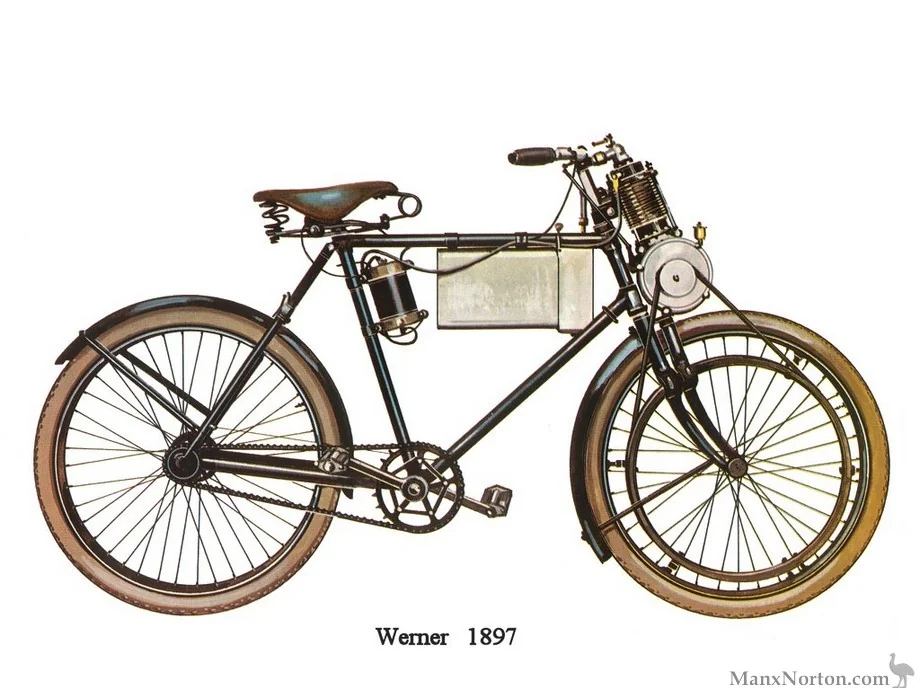
Article Complete Info
| Articleid | 526811 |
|---|---|
| Category | Allround |
| Make | Werner |
| Model | Motocyclette |
| Year | 1897 |
Chassis, Suspension, Brakes & Wheels
| Frametype | Steel |
|---|---|
| Seat | Bicycle seat |
| Wheels | 26 inch wheels |
Engine & Transmission
| Coolingsystem | Air |
|---|---|
| Displacement | 216.00 ccm (13.18 cubic inches) |
| Driveline | Belt front wheel drive |
| Enginedetails | Single cylinder, four-stroke |
| Enginetype | Mounted on the front steering head |
| Gearbox | 1-speed |
| Topspeed | 43.5 km/h (27.0 mph) |
| Transmissiontypefinaldrive | Belt |
Other Specifications
| Comments | Combined enegine and pedals |
|---|
Physical Measures & Capacities
| Dryweight | 30.0 kg (66.1 pounds) |
|---|---|
| Fuelcapacity | 23.00 litres (6.08 gallons) |
About Werner
Country of Origin:
France
Founder:
Michel & Eugène Werner
Best Known For:
Pioneer motor-bicycles (early 1900s) and the ‘Werner position’ engine layout
Company History
Werner helped define motorcycle architecture by moving the engine from above the front wheel to within the frame—what became known as the ‘Werner position.’ This change improved stability, weight distribution, and serviceability, influencing the industry’s evolution from clip-on engines to purpose-built motorcycles. Werner machines competed in early road events and set patterns for controls and frame geometry that survived long after the brand faded. Their legacy is foundational: a clearer idea of where an engine belongs on two wheels.