
1926
BMW R37 - Specifications & Review
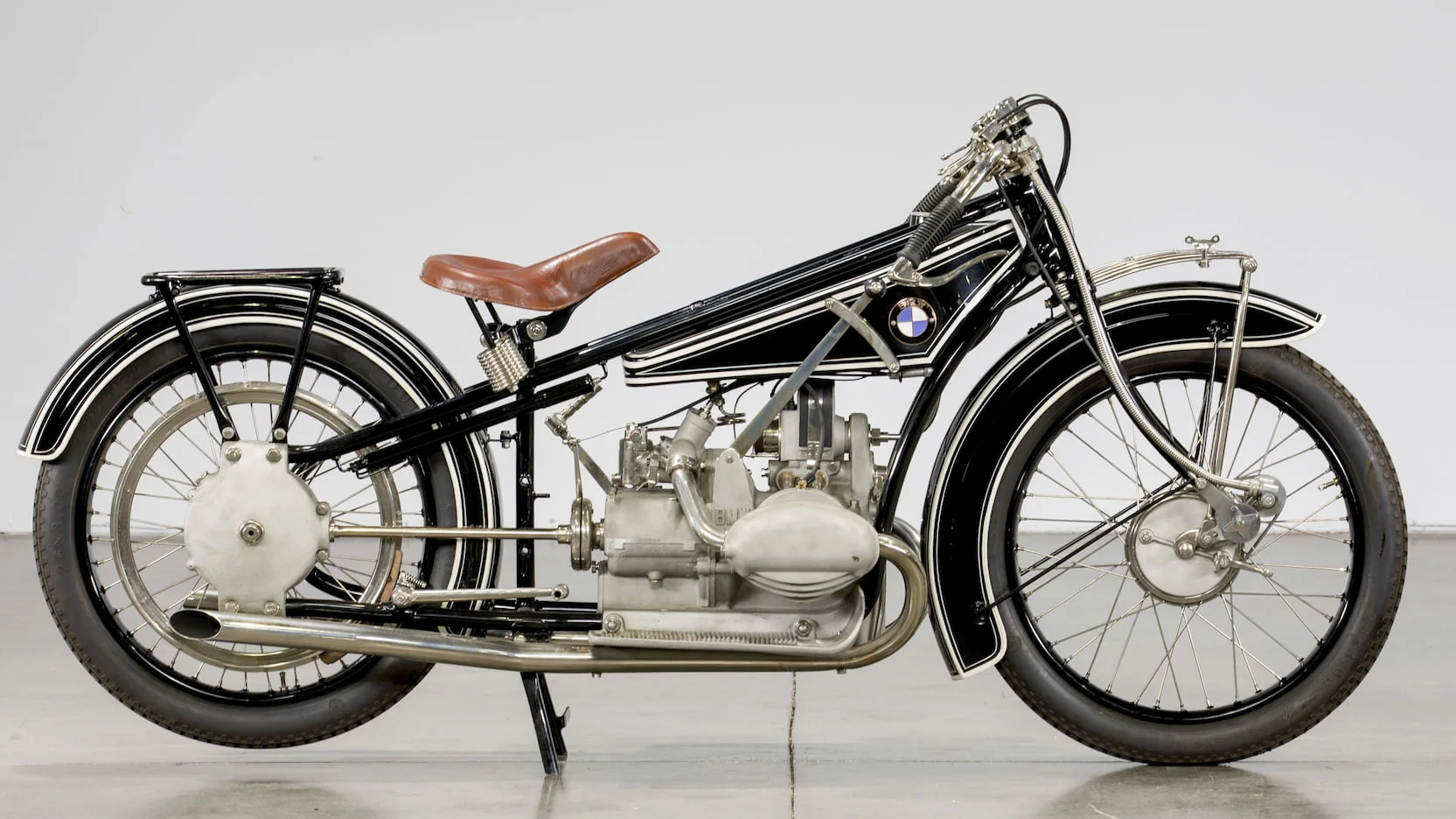
Article Complete Info
| Articleid | 344865 |
|---|---|
| Category | Allround |
| Make | BMW |
| Model | R37 |
| Year | 1926 |
Chassis, Suspension, Brakes & Wheels
| Frametype | Steel doble cradle |
|---|---|
| Frontbrakes | Expanding brake (drum brake) |
| Frontbrakesdiameter | 150 mm (5.9 inches) |
| Frontsuspension | Leading link |
| Fronttyre | 2.99-26 |
| Rearbrakesdiameter | 150 mm (5.9 inches) |
| Rearsuspension | Rigid |
| Reartyre | 2.99-26 |
Engine & Transmission
| Borexstroke | 68.0 x 68.0 mm (2.7 x 2.7 inches) |
|---|---|
| Clutch | Single plate dry-cable operated |
| Compression | 6.2:1 |
| Coolingsystem | Air |
| Displacement | 494.00 ccm (30.14 cubic inches) |
| Enginedetails | Two cylinder boxer, four-stroke |
| Fuelconsumption | 4.00 litres/100 km (25.0 km/l or 58.81 mpg) |
| Fuelsystem | Carburettor. 26mm |
| Gearbox | 3-speed |
| Greenhousegases | 92.8 CO2 g/km. (CO2 - Carbon dioxide emission) |
| Ignition | Bosh magento |
| Lubricationsystem | Wet sump |
| Power | 16.04 HP (11.7 kW)) @ 4000 RPM |
| Topspeed | 115.0 km/h (71.5 mph) |
| Transmissiontypefinaldrive | Shaft drive (cardan) |
Other Specifications
| Starter | Kick |
|---|
Physical Measures & Capacities
| Fuelcapacity | 14.00 litres (3.70 gallons) |
|---|---|
| Overallheight | 950 mm (37.4 inches) |
| Overalllength | 2,100 mm (82.7 inches) |
| Overallwidth | 800 mm (31.5 inches) |
| Weightincloilgasetc | 134.0 kg (295.4 pounds) |
About BMW
Country of Origin:
Germany
Founder:
Roots in Rapp Motorenwerke & Gustav Otto’s firm; BMW AG formation in 1916
Best Known For:
Boxer twins, GS adventure lineage, Telelever/Paralever chassis, and S1000RR superbikes
Company History
BMW Motorrad’s identity crystallized with the 1923 R32 boxer, establishing a flat-twin, shaft-drive template that balanced smoothness, service access, and long-distance durability. Across decades, BMW refined touring and sport-touring with elegant engineering—Earles forks, then Telelever and Paralever to decouple braking and driveline forces, ABS adoption early and widely, and meticulous attention to ergonomics. The 1980 R80G/S essentially invented modern adventure motorcycling, marrying Paris-Dakar toughness to everyday usability; the GS family became a benchmark for balance, electronics integration, and real-world performance. Simultaneously, BMW diversified: silky K-series bricks and later inline-fours culminated in the ferocious S1000RR, a superbike that proved Bavaria could do apex aggression as well as alpine composure. Recent boxers gained liquid cooling and advanced rider aids, while design shifted from conservative to sculptural without losing functional clarity. Historically, BMW stands for engineering seriousness channeled into rider confidence—brakes that inspire trust in the rain, drivetrains that eat continents, and dashboards that tell the truth. Owners speak of a brand that builds companions as much as machines, and of a GS that turns map edges into invitations. From airheads to ShiftCam boxers, BMW’s throughline is thoughtful innovation aimed at making difficult rides feel easy.