
1970
BSA A 50 Royal Star - Specifications & Review
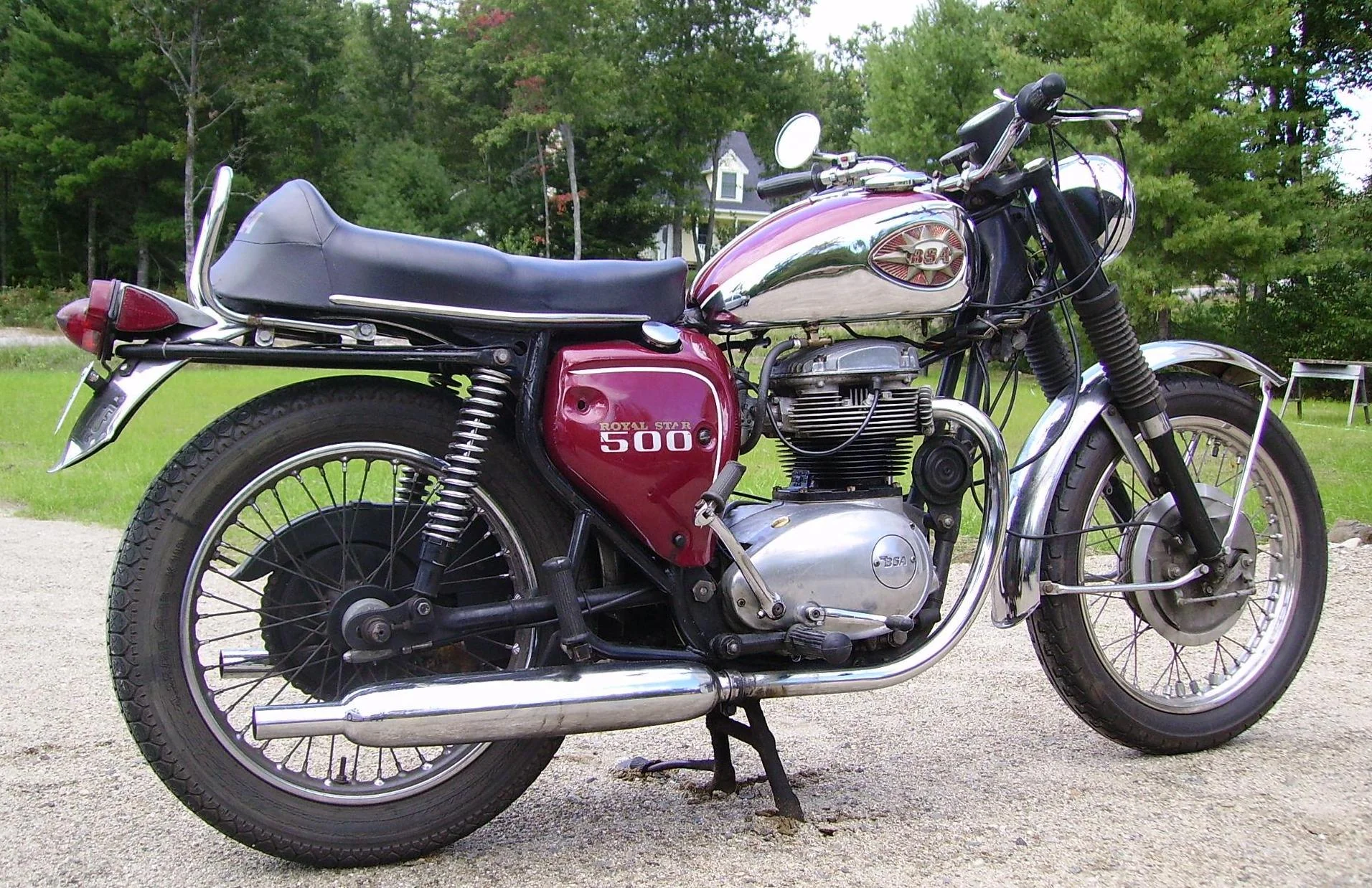
Article Complete Info
| Articleid | 37318 |
|---|---|
| Category | Classic |
| Make | BSA |
| Model | A 50 Royal Star |
| Year | 1970 |
Chassis, Suspension, Brakes & Wheels
| Frontbrakes | Expanding brake |
|---|---|
| Fronttyre | 3.25-19 |
| Rearbrakes | Expanding brake |
| Reartyre | 3.50-19 |
Engine & Transmission
| Borexstroke | 65.5 x 74.0 mm (2.6 x 2.9 inches) |
|---|---|
| Compression | 9.0:1 |
| Coolingsystem | Air |
| Displacement | 498.00 ccm (30.39 cubic inches) |
| Enginedetails | Twin, four-stroke |
| Gearbox | 4-speed |
| Power | 33.00 HP (24.1 kW)) @ 6500 RPM |
| Topspeed | 145.0 km/h (90.1 mph) |
| Transmissiontypefinaldrive | Chain |
| Valvespercylinder | 2 |
Physical Measures & Capacities
| Fuelcapacity | 15.00 litres (3.96 gallons) |
|---|---|
| Weightincloilgasetc | 178.0 kg (392.4 pounds) |
About BSA
Country of Origin:
United Kingdom
Founder:
Birmingham Small Arms Company (consortium of Birmingham gunsmiths, 1861)
Best Known For:
Pre/post-war British singles and twins; Gold Star, A10, and mass-market commuting machines
Company History
BSA—Birmingham Small Arms—grew from an 1861 consortium of Birmingham gunmakers into one of the largest motorcycle producers in the world. By the 1910s the company was turning industrial know-how into dependable motorcycles, and by the post-WWII boom it became a household name across the Commonwealth. BSA’s catalog emphasized robust singles and tractable twins that could commute during the week and tour on weekends; models like the B31/B33 and the A-series twins offered approachable torque and parts you could service with basic tools. The Gold Star—particularly the DBD34—cemented BSA’s sporting credibility, its big single thumping to victory in clubman racing and inspiring café-racer culture. Industrial scale was BSA’s advantage and, ultimately, its challenge: as Japanese manufacturers arrived with oil-tight engines, electric starters, and ruthless pricing, Britain’s fragmented industry struggled to modernize. BSA merged into the larger BSA/Triumph complex and production waned in the 1970s. Yet the badge never lost its emotional pull. Gold Stars, Shooting Stars, and A10s remain staples of classic meets, prized for their mechanical honesty and the cadence of long-stroke British engineering. In recent years, revival attempts have leveraged modern manufacturing while retaining the badge’s gentleman-racer aura. Historically, BSA’s significance transcends any single model: it put motorcycling within reach of the masses, trained generations of mechanics, and defined the look and sound of mid-century Britain—oil-speckled boots, enamel badges, and the steady heartbeat of a big single heading for a coastal B-road.