A Patchwork of Mandatory Helmet Laws in America
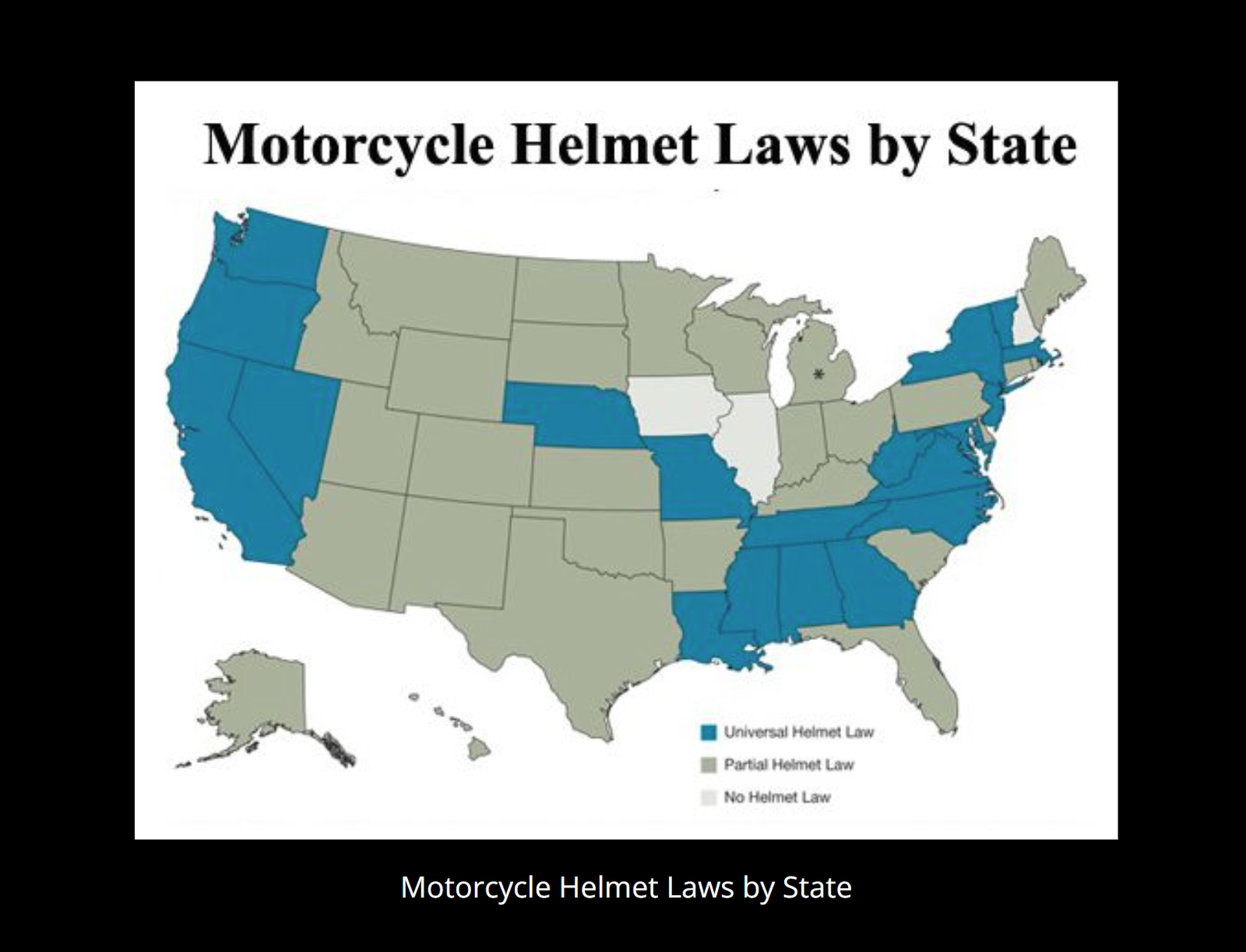
If you take a trip across the United States, you’ll experience firsthand the confusing landscape of Mandatory Helmet Laws. In some states, you will see all motorcyclists strapping on a helmet; in the very next state, you may observe guys bareheaded on bikes at their full speed. As of mid-2025, 19 states and the District of Columbia require all riders to wear head protection when they cycle.
These are known as universal helmet laws. Meanwhile, 28 states only mandate helmets for specific groups (usually riders under 18 or 21), and just three states — Illinois, Iowa, and New Hampshire — have no Mandatory Helmet Laws at all, leaving helmet use entirely up to personal choice.
This conflicting state of things is a result of many years of intense political negotiations. The federal government once urged all states to implement general helmet laws in the late 60s, and almost every state did it. Almost all states had them. But soon, those days of pressure came to an end, and as a result, many states got rid of their own laws. What we have now is a situation where the inequality is seen – in some places a rider needs a helmet according to regulations, while in others, it is optional rather than mandatory.
Renting a motorcycle and coming from California (a state using a universal law) on a journey to the east, a rider may find it legal not to wear a helmet as a thing in Arizona (where the only law is for those riders who are 17 or younger). Such an inconsistency can indeed create confusion. The issue of Mandatory Helmet Laws isn’t just about personal freedom; it also touches public health, insurance costs, and state policy.
The notions are generally quite different when it comes to the laws of the helmet and the loss of liberty that some states see it through the prism of personal freedom or elsewhere the states with strict rules point out the assigned safety benefits of the helmet step the statistics just like a sword to the neck, according to the CDC, helmets decrease the probability of motorcyclist death by 37% and head injury by 69%. Observed helmet use is about 83% in states with universal laws, but only about 66% in states without such laws. These percentages back up the idea of safety; however, it is not merely statistics that matter to riders.
The Safety Perspective: “Helmets Save Lives”
According to the current view of the case, helmets are the protective devices that decrease the rate of death and serious injury in accidents overwhelmingly. The statements have been made by organizations like the National Highway Traffic Safety Administration (NHTSA) and the Insurance Institute for Highway Safety (IIHS), which illustrate their ability to provide solid evidence that supports the efficacy of helmets. One of the prevails of logic is that as the motorcyclist does not have a car in the first place, he is exposed to danger and, in a specific avoid, he can extremely only be injured in the head. A proper helmet protects the motorcyclist from traumatic brain injury as it is the last line of defense.
A frequently cited statistic from NHTSA: helmets are 37% effective in preventing motorcycle deaths (for riders) and about 41% for passengers. They’re even more effective at preventing brain injuries. “Wearing a helmet is one of the biggest things riders can do to protect themselves from death and traumatic brain injury,” says IIHS director David Teoh. It’s no wonder that public health officials often call helmets the motorcycle equivalent of seatbelts.
Universal Mandatory Helmet Laws also benefit society by lowering medical costs and insurance claims. When riders collide without helmets, the injuries can be more severe, and the medical costs are often passed on to the society/social insurance through increased premiums or taxpayer-funded emergency care. In fact, a IIHS study in 2023 pointed out that the number of motorcyclist lives could have been saved was above 20,000, if all states had a universal helmet law from 1976 to 2022.
In other words, this was about 11% of all the rider fatalities within that timeframe. IIHS President, David Harkey, said, "It is plain and obvious that all riders should be forced to put on helmets just like in the case of people in cars fastening their seatbelts." This statement goes to the heart of the Mandatory Helmet Laws debate. The reasons are given that after some states had repealed or highlighted the helmet mandating laws in 2000s, their mortality rate of motorcyclists increased. Going to the other side, it was when Louisiana or Nevada states removed the universal law, then the people who have died got decreased.
Such findings consistently reinforce one conclusion: helmet laws save lives. Many health, safety, and insurance organizations—including the National Transportation Safety Board (NTSB)—strongly advocate for universal adoption of Mandatory Helmet Laws across all U.S. states, calling them a vital step toward reducing preventable rider deaths.
Safety proponents often frame it not as an attack on riders’ rights, but as a matter of public responsibility. They note that motorcycling inherently carries risks, but wearing a helmet is a simple measure to mitigate one major risk (head trauma). To them, opposing helmets is akin to arguing against life jackets on a boat. From their viewpoint, the inconvenience or slight discomfort of a helmet is a small price to pay to prevent a lifetime of disability or loss of life.
Some will emotionally cite examples of riders who crashed at relatively low speeds, sustained a head injury, and never recovered – tragedies that might have been prevented with a DOT-approved helmet. These cases underscore the power of science and statistics behind Mandatory Helmet Laws, though the debate remains emotionally charged on both sides.
The Freedom Perspective: “Let Those Who Ride Decide”
Opponents of Mandatory Helmet Laws argue the choice should rest with the individual, not the government. For example, ABATE (A Brotherhood Against Totalitarian Enactments) has always lobbied the state legislatures to abolish or loosen helmet requirements under the slogan “Freedom of choice.”
For such people, mandates for using a helmet are part of the government having authority embodied in a parent-related way – they are seen as interference in personal decision-making and the risks one opts for. They put it forward that unlike the many risky sports where adults can take part in high-altitude mountaineering etc. without specific helmet laws, motorcycling is singled out; no motorcycle-only laws are needed. Some also argue that the helmet laws unfairly highlight motorcyclists while there are many forms of transport that are dangerous in a similar way.
One prominent voice is Maryland ABATE chairman Bob Spanburgh, who has spent decades fighting his state’s helmet law. “We have some pretty ardent supporters. We have a lot of people who think we’re nuts, probably,” Spanburgh quipped about their persistent lobbying efforts. The sentiment is echoed by lawmakers sympathetic to the cause. “I firmly believe that we as government do better when we educate people, rather than legislating something,” said Maryland State Senator Mike McKay, who introduced a bill to relax helmet laws in 2024.
“There are people that would like to have the choice [to not wear a helmet]. And I tend to believe that we should give people the choice but 100% support educating them about it.” This encapsulates the freedom argument: adults should be free to make their own informed decisions regarding helmet use, and the state’s role should be to provide safety education, not impose blanket requirements.
Personal liberty isn’t the only driver of opposition. Some riders simply feel that helmets can be uncomfortable, limit their field of view or hearing, or undermine the joy of riding (the feeling of wind in one’s hair, etc.). They argue that in certain scenarios – say a slow-speed cruise on a quiet rural road – the risk is minimal and they should be allowed to go without a lid if they accept that risk. There’s also a cultural aspect: for some cruiser and chopper riders, not wearing a helmet is almost an identity statement, symbolizing rebellion and connection to the open road ethos.
For them, Mandatory Helmet Laws symbolize restriction, not safety. Instead, they promote education, voluntary use, and rider responsibility. What they oppose is the mandatory aspect. ABATE chapters frequently run rider training and safety programs, promoting helmets as a smart choice but opposing making them compulsory for adults. Their motto “Let those who ride decide” emphasizes individual responsibility over government mandate.
The Ongoing Debate and Recent Developments
In 2025, Mandatory Helmet Laws continue to divide the motorcycling community. Some states have seen recent efforts to either repeal or strengthen helmet laws. For instance, in West Virginia a bill was floated to relax their universal law, prompting public debate and input from both ABATE and medical professionals.
Conversely, states like Connecticut have considered moving from a partial law (under 18) to a universal law after seeing an uptick in rider fatalities. California – often at the forefront of vehicle regulations – is taking a different tack by looking to increase electric motorcycle adoption and perhaps tying that to safety initiatives. Nationally, there hasn’t been federal helmet law pressure in years, so this fight is largely statehouse to statehouse.
One notable development: in 2024, California’s Air Resources Board proposed rules not directly about helmets, but highlighting the environmental impact of motorcycles (and by extension, all the more reason to ensure motorcyclists stay safe). It was pointed out that motorcycles, while fewer in number than cars, can emit disproportionately high levels of certain pollutants – reinforcing the idea that every facet of motorcycling, including rider safety, faces scrutiny.
Though California didn't change its helmet law (it has mandated helmets since 1992, and this is not likely to change), the debate in the public forum is sometimes linked with helmet use as well as the motorcycle community overall. Some riders resonate with the notion that if all of them wore helmets in masses, it would have a positive impact not only on the public perception but also on the legislative goodwill, which could even then, of course, direct more attention to other issues such as better road safety or car driver awareness.
In states with active repeal efforts, the familiar arguments get trotted out each legislative session. Often, a compromise gets proposed – like only requiring helmets for young riders, or for riders who haven’t taken a safety course, etc. Michigan, for example, repealed its universal law in 2012 but requires helmetless riders to carry additional insurance and be over 21 with some training. It’s a middle-ground approach that, while still controversial, attempts to address some safety concerns. The debate thus evolves: not just black-and-white “law or no law,” but shades of conditional requirements.
Meanwhile, the toll of not wearing helmets continues to surface in accident data. One can find tragic local news stories of a rider who died in a crash that, according to authorities, “likely would have been survivable had they been wearing a helmet.” Advocates on each side often latch onto specific cases to make their point. A freedom advocate might say, “That rider knew the risk and sadly paid the price – but it was their choice.” A safety proponent might counter, “Had the law required it, they’d be alive.” And round and round it goes.
Reaching Accord and Progressing
Though the two sides very often seem to be standing firmly on their respective positions, they do have some common ground. The safety advocates and the freedom advocates stick to the point of rider education and training being highly needed by both safety and freedom advocates. Whether the helmets are obligatory or not, the courses that all riders take, about risk awareness, bike handling, and using protective gear, are very beneficial for all of them.
The states are replete with first-rate rider training programs, most of which are partially subsidized or are free for new riders, and even ABATE groups regularly run or sponsor safety courses. The shared goal of increasing enrollment in these courses has been set – a well-trained rider is less likely to crash, whether or not he/she wears a helmet.
Another area of agreement is fortifying other aspects of motorcycle safety: better awareness campaigns for drivers to look out for motorcycles, improved road maintenance (hazards like potholes can be extra deadly for two wheels), and smarter enforcement of distracted driving laws. In states with partial helmet laws, there’s consensus that at least young riders should wear helmets – virtually no one suggests minors should be helmet-free. So, ensuring youth riders and passengers are protected is a baseline.
Not only that, but it should also be said that the helmets of today have advanced a lot. The contemporary helmets are lightweight, very breathable and they even have a Bluetooth connection and other facilities. Now that they get more comfortable, those who once considered not to wear helmets are prepared to put them on (mandatory or not). Such an association can be taken to industry and rider groups to jointly announce the irrefutable evidence that helmets are not burdensome.
Will there ever be a nationwide universal helmet mandate? Not in the current political climate and with the strong opposition in some areas. The overall trend in the last several decades has been the easing laws quite frequently instead of making them stricter. Yet, change comes through like a swing of the pendulum. The situation will change if the number of motorcyclists dying grows out of control, mostly in states without helmet laws; public attitude can be switched. Just Like seatbelt and smoking laws before them, Mandatory Helmet Laws might one day become normalized as public perception shifts.
The best way forward, for now, is to mix continued education, personal responsibility, and respectful dialogue. In no-law states, the riders can still lead by example –actually, even in a state where the law does not require it, choosing to wear a good quality helmet (and other protective gear) may persuade others, without being mandatorily required. Likewise, those who choose to ride without can still encourage respect for safe riding practices and those who do wear lids.
The motorcycling community is diverse but as far as risks are concerned we have one road and the same risks to share. If you are on the side of “safety” or “freedom” in the helmet discussion we are all in wanting to ride and come back home alive.
The helmet debate is still vibrant in 2025. However, through the process of discussion and mutual concern for the well-being of riders. we may also eventually reach the end of the deadlock. Rider gear is not just about helmets. Regardless of your state’s stance on Mandatory Helmet Laws, the smartest choice is always the same: gear up, ride alert, and protect yourself. In layman's terms, the goal is the same as the aim for everyone is to enjoy the ride and be alive to drive again.