
1959
Simson 425 GS - Specifications & Review
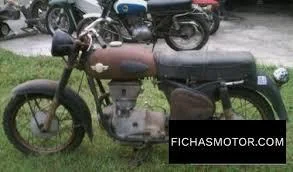
Article Complete Info
| Articleid | 391283 |
|---|---|
| Category | Sport |
| Make | Simson |
| Model | 425 GS |
| Year | 1959 |
Chassis, Suspension, Brakes & Wheels
| Frontbrakes | Expanding brake (drum brake) |
|---|---|
| Frontsuspension | Telescopic |
| Fronttyre | 3.5-19 |
| Rearbrakes | Expanding brake (drum brake) |
| Rearsuspension | Swingarm |
| Reartyre | 4-18 |
| Seat | Single |
Engine & Transmission
| Borexstroke | 68.0 x 68.0 mm (2.7 x 2.7 inches) |
|---|---|
| Coolingsystem | Air |
| Displacement | 247.00 ccm (15.07 cubic inches) |
| Enginedetails | Single cylinder, four-stroke |
| Fuelconsumption | 3.30 litres/100 km (30.3 km/l or 71.28 mpg) |
| Fuelsystem | Carburettor |
| Greenhousegases | 76.6 CO2 g/km. (CO2 - Carbon dioxide emission) |
| Ignition | Magneto |
| Power | 17.50 HP (12.8 kW)) @ 7200 RPM |
| Transmissiontypefinaldrive | Shaft drive (cardan) |
Physical Measures & Capacities
| Dryweight | 157.0 kg (346.1 pounds) |
|---|---|
| Powerweightratio | 0.1115 HP/kg |
About Simson
Country of Origin:
Germany (former GDR)
Founder:
Simson & Co., Suhl (origins in 19th-century industry)
Best Known For:
Durable small two-strokes (S50/S51, Schwalbe) ubiquitous across the GDR
Company History
Simson’s mopeds and light motorcycles mobilized East Germany for decades. The Schwalbe scooter and S-series step-throughs were engineered for everyday survival—oil-bath chains, robust electrics, generous ground clearance, and engines that forgave indifferent fuel. Parts were available in village shops; owners learned maintenance as a civic skill. After reunification, Simson machines became cult classics: simple, charming, and legal oddities in some regions thanks to transitional rules. Clubs keep them alive with reproduction spares and shared know-how. Historically, Simson symbolizes transport as infrastructure under constraint: make it fixable, make it last, and let it be the tool that carries a nation to work, to school, and to weekend lakes on the same faithful cylinder.