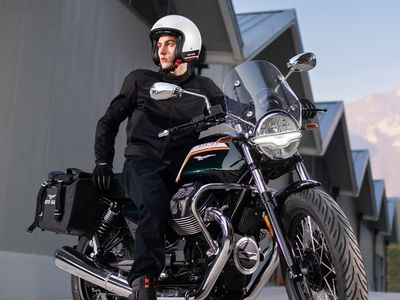
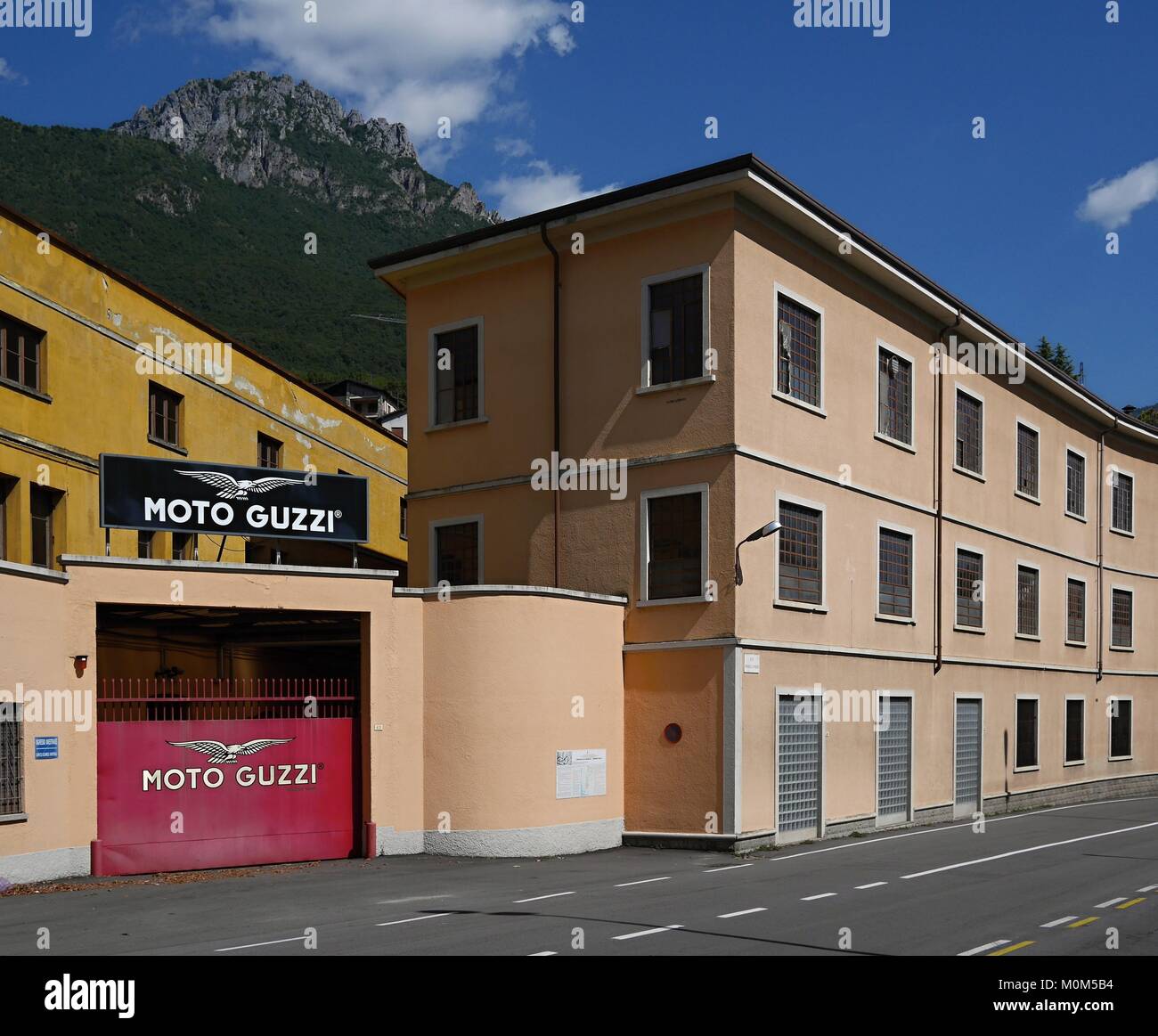
Few names in motorcycling carry the romantic weight of Moto Guzzi. Founded in 1921 on the shores of Lake Como in Mandello del Lario, Italy, the brand has spent over a century building machines that blend character, soul, and genuinely distinctive engineering. Now, according to recently filed patent documents, Moto Guzzi is preparing to take its boldest engineering step in decades — a brand-new V4 powertrain that could reshape the entire model lineup by the end of the decade.
What the Patent Actually Reveals
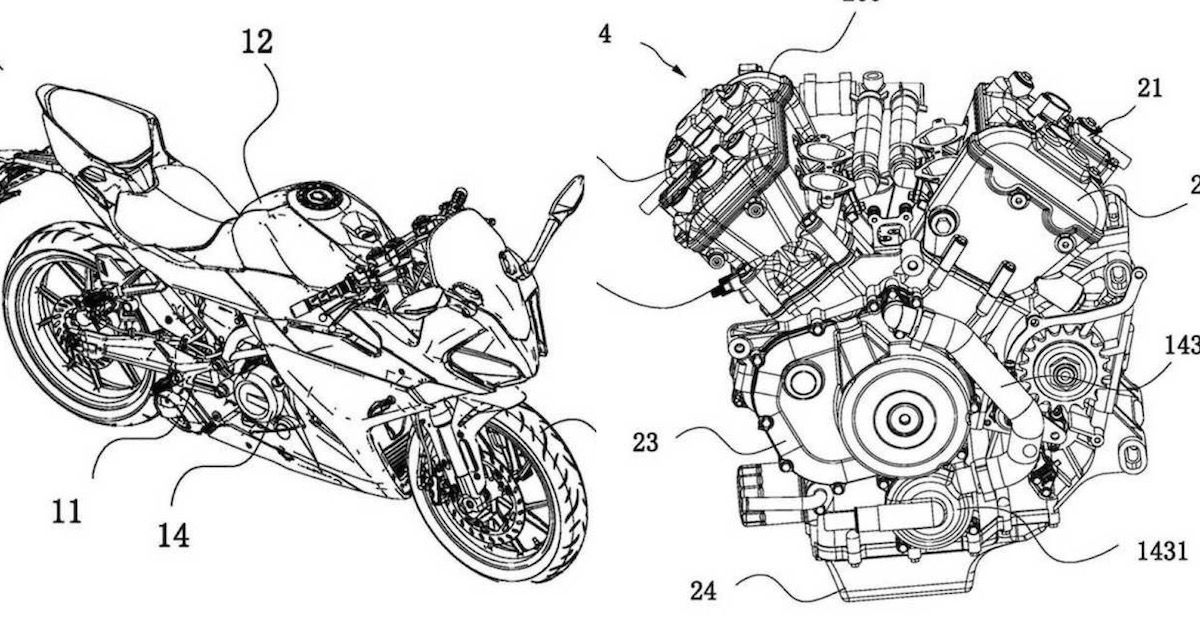
The patent filing, submitted through Piaggio Group's intellectual property channels, describes a transversely mounted, water-cooled V4 engine architecture. This is significant for several reasons. Moto Guzzi has long been defined by its longitudinally mounted, air-cooled V-twin — a configuration so iconic that it became inseparable from the brand's identity. A move to a V4 layout, and a transverse one at that, represents a philosophical shift as much as an engineering one.
The patent drawings show a compact, relatively narrow V-angle configuration — reportedly in the 70- to 90-degree range — which would help manage overall engine width, a common challenge with transverse V4 designs. The documents also indicate dual overhead camshafts, variable valve timing provisions, and what appears to be a wet-sump lubrication system. Bore and stroke figures are not confirmed in the patent language, but the overall displacement is widely speculated to fall in the 1,000cc to 1,200cc range based on cylinder bore dimensions visible in the technical drawings.
The Platforms: V100 Mandello and Stelvio
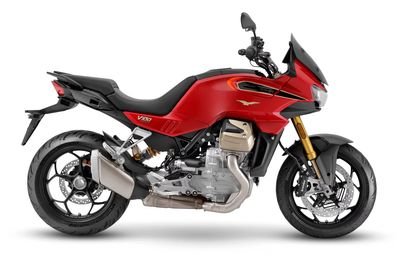
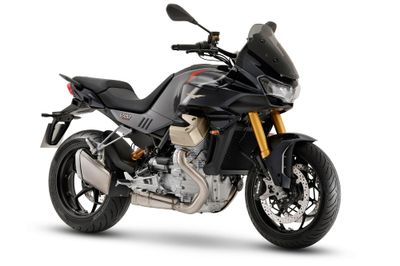
Perhaps the most intriguing element of this patent is its apparent dual-platform intent. Insider sources and patent analysis suggest the new V4 is being engineered as a shared powertrain across two of Moto Guzzi's most important modern products: the sport-touring V100 Mandello and the adventure-touring Stelvio.
V100 Mandello
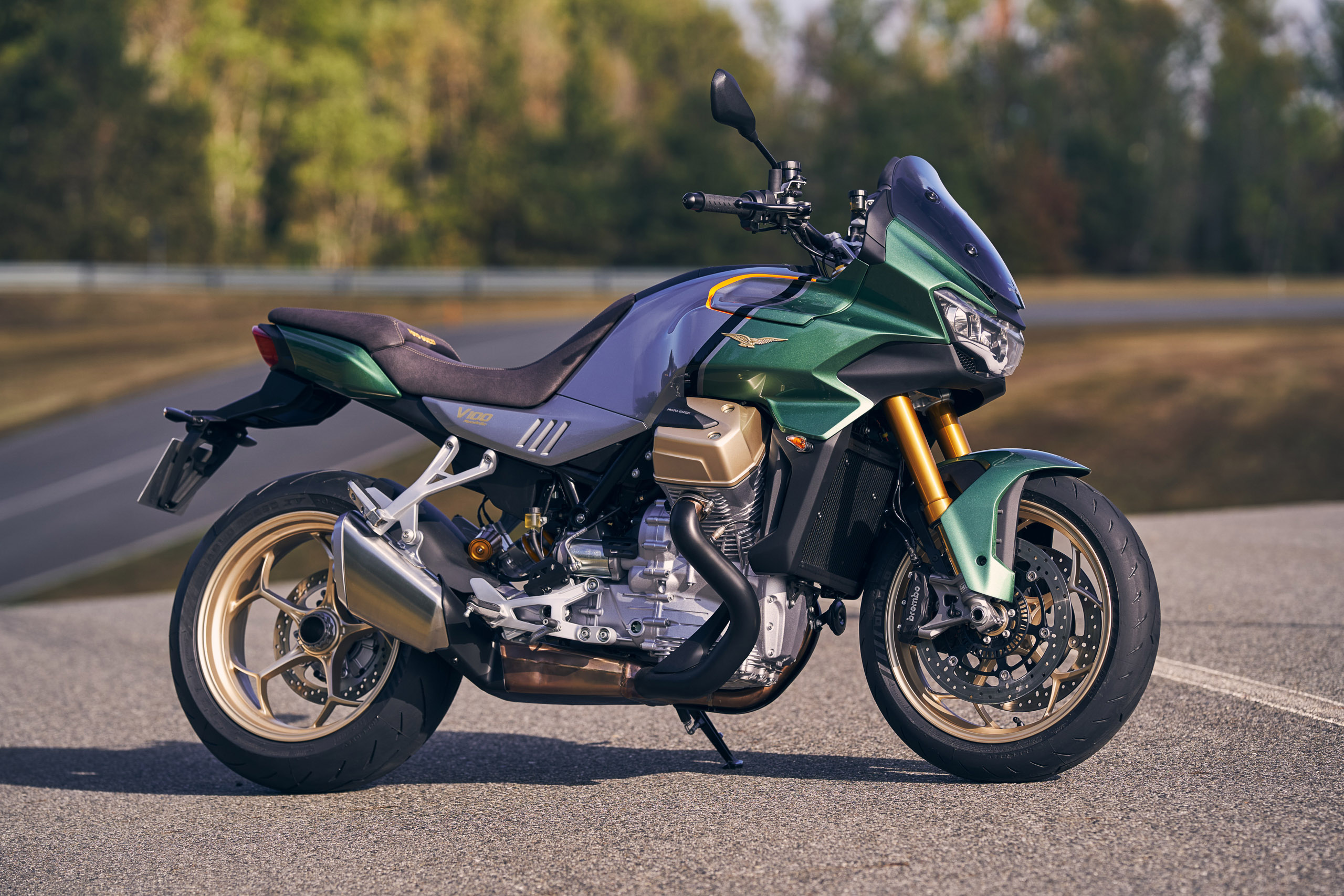
The V100 Mandello launched in 2022 to considerable fanfare, introducing adaptive aerodynamics — retractable side wings — that generated real buzz in the sport-touring segment. Powered by the current 1,042cc V-twin making around 115 horsepower, it's an impressive machine. But a V4 upgrade would transform its performance profile dramatically, with potential output figures rumored to exceed 150 horsepower while retaining strong low-end torque. The chassis would likely be revised or entirely new to accommodate the different engine geometry, and the adaptive aero system could be further developed to complement the added performance.
Stelvio
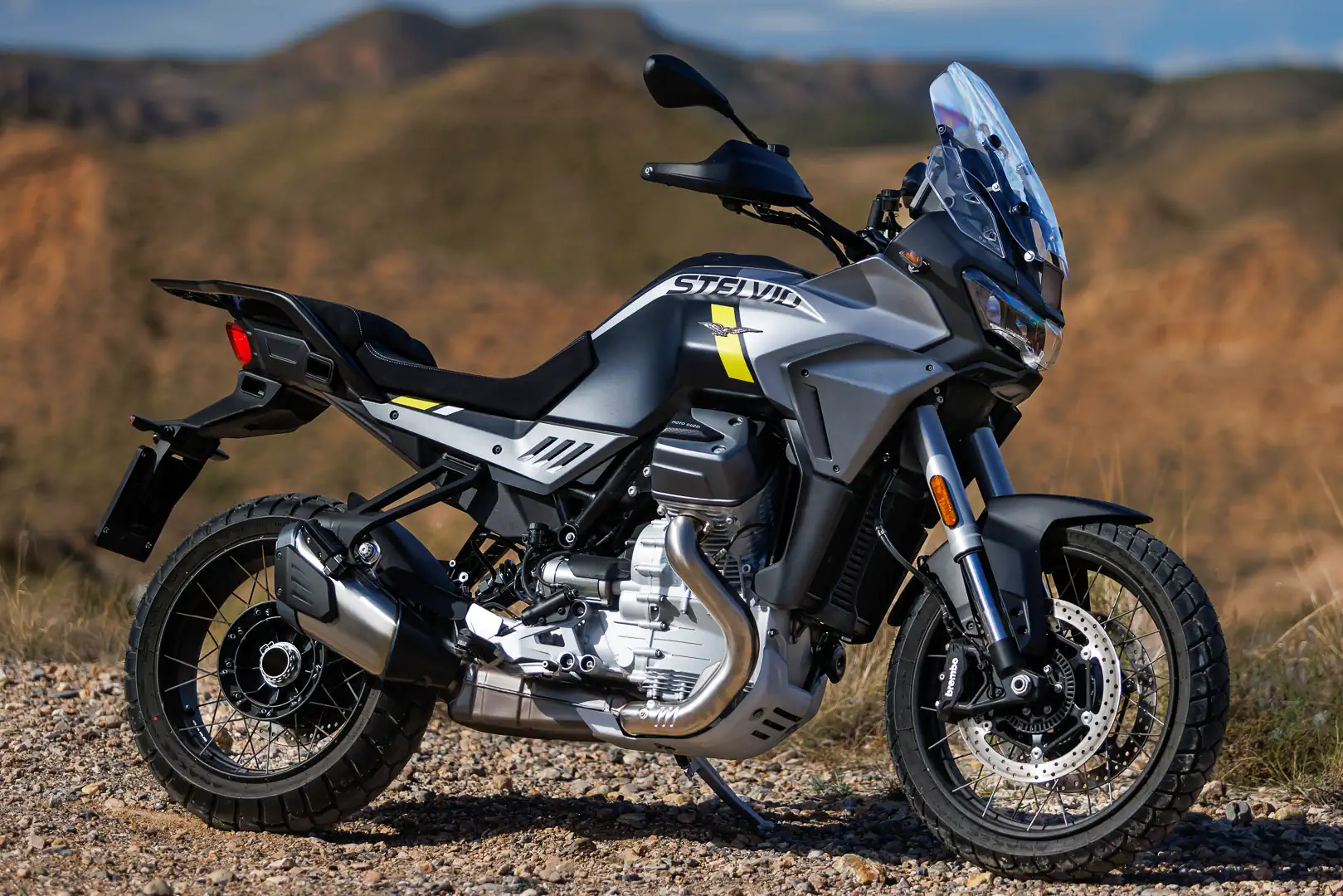
The Stelvio, Moto Guzzi's answer to the premium adventure-touring segment occupied by the BMW R1250GS and Ducati Multistrada, currently shares the same V-twin architecture. A V4 powertrain would give the Stelvio the firepower to genuinely compete at the top of that class. Riders who love the Stelvio's Italian character but have wanted more outright performance will be watching this development very closely. The added power delivery of a V4 could also offer smoother, more refined throttle response across diverse off-road and highway conditions — exactly what adventure riders demand.
Why a V4? The Engineering Case
Skeptics will ask: does Moto Guzzi really need to abandon its signature twin? The honest answer is nuanced. The V-twin remains beloved and will almost certainly continue in other models. But in the premium sport-touring and adventure-touring segments, displacement and cylinder count increasingly define customer expectations. Competitors like Ducati (with the Multistrada V4), Aprilia (RSV4 and Tuono), and even Honda (Gold Wing) have demonstrated that V4 engines offer a unique combination of power density, refinement, and character that a twin simply cannot replicate at the same displacement.
A transverse V4 also opens up significant packaging advantages. Engineers can optimize weight distribution, lower the center of gravity, and potentially route exhaust systems more efficiently — all of which benefit handling. The narrower effective engine width compared to a longitudinal twin could also improve cornering clearance, a genuine performance factor for both the Mandello's sport-touring mission and the Stelvio's mountain-road versatility.
Technology Expectations
Based on the patent language and Piaggio Group's current technology direction, riders can expect the new V4 to arrive with a comprehensive electronics suite. Here's what the platform will likely offer:
- Variable valve timing: Hinted at in the patent drawings, this would allow the engine to optimize performance and efficiency across its RPM range.
- Multiple riding modes: Sport, Road, Rain, and likely an off-road mode for the Stelvio variant.
- Advanced traction control and cornering ABS: Standard expectations for this class by the late 2020s.
- Semi-active suspension: Both platforms already offer or will likely offer electronically controlled suspension, which would be recalibrated for the new engine's power delivery.
- Connectivity and TFT instrumentation: A fully connected dashboard with smartphone integration, navigation, and over-the-air update capability.
- Euro 6 compliance: The engine will be developed from the ground up to meet increasingly stringent emissions standards projected for the 2027-2029 timeframe.
Timeline: What to Expect and When
Patent filings typically precede production introductions by three to five years, placing the most optimistic arrival window around 2027 and a more realistic full production and retail timeline around 2028 to 2029. Industry watchers speculate that Moto Guzzi could debut a concept or prototype at EICMA — the Milan Motorcycle Show — as early as 2026, using the event to gauge market reaction and generate pre-launch excitement, a strategy Piaggio Group has employed effectively in the past.
It's worth noting that patent filings do not guarantee production. Manufacturers file patents for technologies that are actively developed, shelved, or sometimes licensed to others. However, given the strategic importance of the V100 Mandello and Stelvio to Moto Guzzi's premium positioning, and the competitive pressure the brand faces in those segments, the business case for this powertrain investment appears strong.
What This Means for Riders and Enthusiasts
For current V100 Mandello and Stelvio owners, this news is both exciting and potentially bittersweet. On one hand, it validates the platform investment those riders made. On the other, it signals that significantly more capable versions of their bikes are coming. Resale value considerations may apply, though it's worth noting that Moto Guzzi's typically strong build quality and brand loyalty tend to support used values well even through generational transitions.
For prospective buyers sitting on the fence, the calculus is harder. The current V-twin models are genuinely excellent motorcycles — refined, characterful, and very capable. Waiting five years for a V4 variant means five years of not riding one. That said, if you're in the market for a machine you plan to keep for a decade or more, knowing a generational update is coming is valuable information.
The Bigger Picture: Moto Guzzi's Modern Ambitions
This patent is part of a broader story about Moto Guzzi's reinvention under Piaggio Group's stewardship. After years of existing on nostalgia alone, the brand has committed serious engineering resources to modernization — the V100 Mandello's adaptive aerodynamics being the clearest example. A V4 powertrain would be the definitive statement that Moto Guzzi is not content to be a boutique curiosity, but rather a genuine contender in the upper echelon of premium motorcycling.
The Italian soul, the craftsmanship, the emotional connection riders feel to these machines — none of that needs to change with a V4. If anything, the best version of Moto Guzzi's future might be one where cutting-edge performance meets that unmistakable Italian character. Based on what this patent suggests, that future is being engineered right now on the shores of Lake Como.