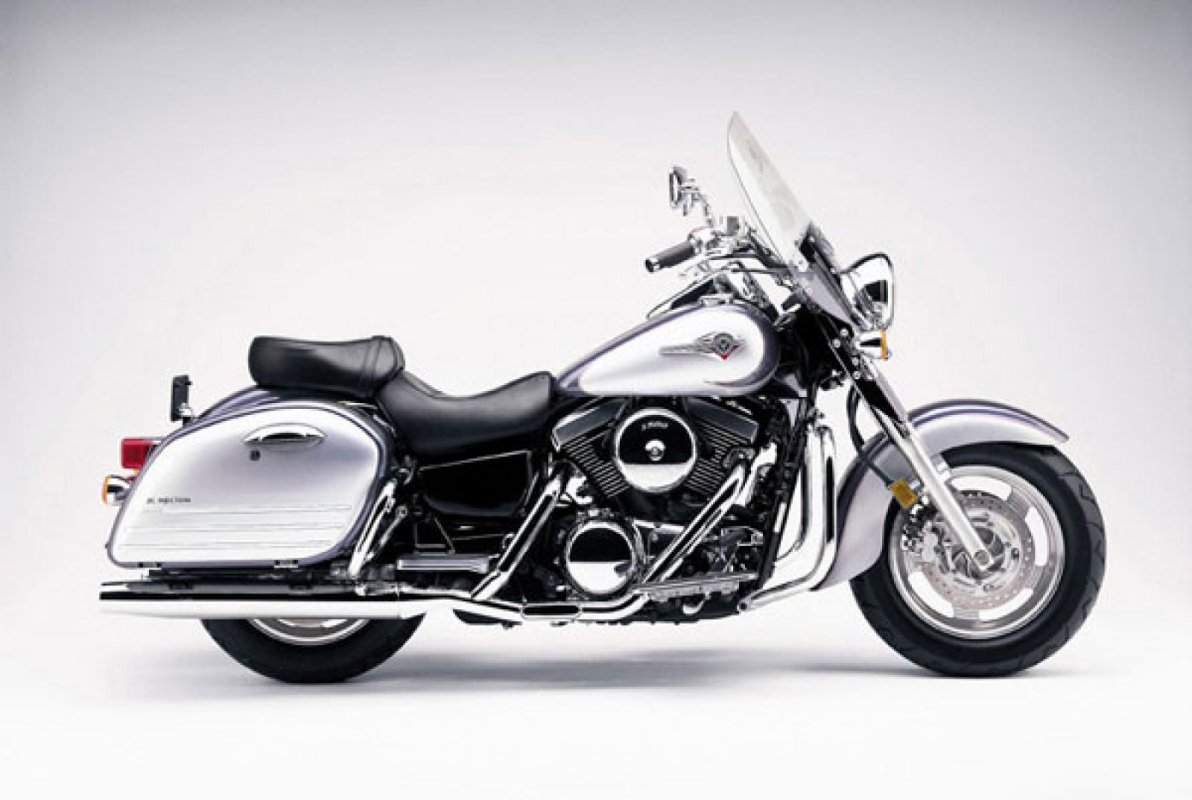
If those swoopy skirted fenders ever made you stop mid–gas-station exit, you were likely staring at a Kawasaki Vulcan 1500 Drifter. Built from 1999–2005, it’s a 1940s streamliner homage with modern reliability—liquid cooling, (mostly) fuel injection, a hidden rear mono-shock, and a torquey big twin that loafs along for days. Classic vibes, without vintage headaches.
The Vibe: Classic Looks, Modern Ease
The Drifter’s silhouette is pure nostalgia—deep valanced fenders, tombstone tail, minimal badging, and (on early models) an elegant solo seat. Yet living with it is modern: Kawasaki tucked a mono-shock under the “hardtail” look, so it glides over rough pavement instead of punishing you. It’s the kind of machine that turns a grocery run into a small car-show, then idles home like a couch on two wheels.
Engine & Chassis: Calm, Cool, and Torquey
Under the tin: a SOHC 50° V-twin (1470–1498cc) that favors low-rpm shove and a mellow cadence.
- Output: ~60–70 hp / ~80–90 lb-ft
- Happy zone: 2,000–3,500 rpm—traffic friendly, relaxed at cruise
- Fueling: EFI on most 1500 Drifters (some carb’d by market/year)
- Transmission/Drive: 5-speed with Shaft drive (quiet, low-maintenance)
- Suspension: Conventional fork + hidden mono-shock
- Brakes: Dual front discs + rear disc (progressive, confidence-inspiring)
- Seat Height / Wet Weight: ~27 in / ~720–750 lb (trim dependent)
This isn’t a power-cruiser. It’s long, low, and stable, rewarding smooth inputs, mindful floorboard clearance, and an unhurried pace.
Model Notes (1999–2005)
The Vulcan 1500 Drifter debuted in 1999 (VN1500J) with the cleanest, most “purist” silhouette—solo saddle, minimal trim, and those glorious skirted fenders taking center stage. From 2000 through 2005, Kawasaki leaned into comfort and distance: two-up seats and touring accessories became more common, the color palette broadened, and small updates to fueling and ergonomics refined the ride without diluting the look. As a lighter alternative, the Drifter 800 mirrored the same art-deco styling cues in a more manageable package, capturing the vibe with easier weight and reach.
On the Road: What It Feels Like
Powering the Drifter is a response to the opening of the handle with a linear, pleasant surge-bringing the torque right off idle, so there is no need to push the redline to reach a smooth and consuming progress. But the most marvelous part is that the ride quality is truly miraculous. The concealed rear shock is the discreet hero, by keeping things soft and comfortable even on broken pavement; add a windshield and saddlebags and you have the ease of touring. Ergonomics are the ones that make the situation perfect-the low seat and wide bars let the stop-and-go easy as well as the shoulders relaxed at speed, while the taller riders can adjust the reach with just simple pullbacks or a different saddle.
Add wind protection and luggage, and the Drifter becomes an effortless weekend tourer.
Popular Upgrades
- Touring: Quick-release windshield, saddlebags, luggage rack
- Comfort: Plush two-up saddle (or keep the solo pan for the purist vibe)
- Sound/Driveability: Slip-ons + EFI tune (or jets on carb years) for a deeper rumble
- Ergos: Bar risers, adjustable levers, highway pegs
Known Quirks (and Easy Fixes)
- Cam-chain tensioner wear (some Vulcan 1500s): Listen for warm-idle rattle; many owners fit tensioner extenders proactively.
- Aging electrics: Inspect connectors/relays; a dab of dielectric grease helps long-term.
- Valanced fenders: Gorgeous but mind the mounting spacers/torque to avoid stress cracks.
- Tires: Whitewalls complete the look; proper pressure keeps steering light.
Used Buyer’s Checklist
- Cold start & idle (smooth EFI/carb behavior; no coughing/backfire)
- Warm cam-chain noise (ask about tensioner history)
- Charging health (battery age, regulator output)
- Fender fit/finish (cracks, misaligned hardware)
- pulleys (even wear, correct tension)
- Add-ons & records (clean title, maintenance proof, tidy wiring)
A cared-for Drifter with 20–40k miles is common and nowhere near end-of-life.
Spec Snapshot (Typical Vulcan 1500 Drifter)
| Item | Spec (typical) |
|---|---|
| Engine | SOHC 50° V-twin, liquid-cooled |
| Displacement | 1470–1498 cc |
| Output (approx.) | 60–70 hp / 80–90 lb-ft |
| Fueling | EFI (most years; some markets carb) |
| Transmission | 5-speed |
| Final Drive | Shaft |
| Seat Height | ~27 in (685 mm) |
| Wet Weight | ~720–750 lb |
| Fuel Capacity | ~5.0 gal (~19 L) |
Figures vary slightly by year/market.
Model Timeline & Highlights (1999–2005)
| Year/Code | Key Features & Changes | Notes |
|---|---|---|
| 1999 J | Launch; solo seat, minimal trim, cleanest lines | Collector favorite |
| 2000–2001 | Wider color palette; touring accessories more common | Subtle fueling/ergonomic tweaks |
| 2002–2003 | Ongoing refinements; EFI prevalent by market | Popular years for two-up setups |
| 2004–2005 | Late-run trims; steady spec | Production ends after 2005 |
| 1999–2005 | Drifter 800 sold alongside in many markets | Lighter, same styling |
Drifter vs. The World
| Comparison | Drifter Advantage | Trade-Off |
|---|---|---|
| Vulcan 1500 Classic | Hidden shock + skirted fenders = “factory custom” | Classics more common/cheaper |
| True Vintage | Modern reliability (cooling, EFI, parts) | Vintage has purist provenance |
| Modern Big Twins | Unique period silhouette + easy ownership | Not a hot-rod; calm power delivery |
Pros & Cons
| Pros | Cons |
|---|---|
| Show-stopping streamlined fenders | Heavy; limited lean (cruiser reality) |
| Low seat, relaxed ergos, plush ride | Some model-specific trim can take sourcing effort |
| Shaft drive + understressed twin = easy upkeep | Power is relaxed, not “sporty” (by design) |
| Enthusiast community; rising classic appeal |
Popular Upgrades & What They Do
| Upgrade | Why Add It | Result |
|---|---|---|
| Quick-release windshield | Cut fatigue, extend range | Quieter cockpit, better touring |
| Saddlebags/luggage rack | Weekends & errands | Practicality without killing the look |
| Slip-ons + EFI tune/jetting | Voice + drivability | Deeper tone, cleaner throttle |
| Bar risers/adj. levers/pegs | Fit refinement | Relaxed shoulders, better control |
Buying & Living With One (Quick Tips)
- Sit test > spec sheet: Seat width and sag change real-world reach.
- Mind the fenders: Use correct spacers and torque; avoid ham-fisted installs.
- Preventive TLC: Tensioner extenders, connector care, fresh rubber—cheap insurance.
- Dress it right: Windshield + bags = effortless tourer; solo pan + fishtails = showstopper.
Final Take
The Kawasaki Vulcan 1500 Drifter is rolling art with a serene V-twin soul. It nails the 1940s streamliner look while staying turn-key dependable. If you’re chasing timeless style, easy manners, and a bike that makes strangers grin at traffic lights, a well-kept Drifter delivers—polish it, pack it, and take the long way home.